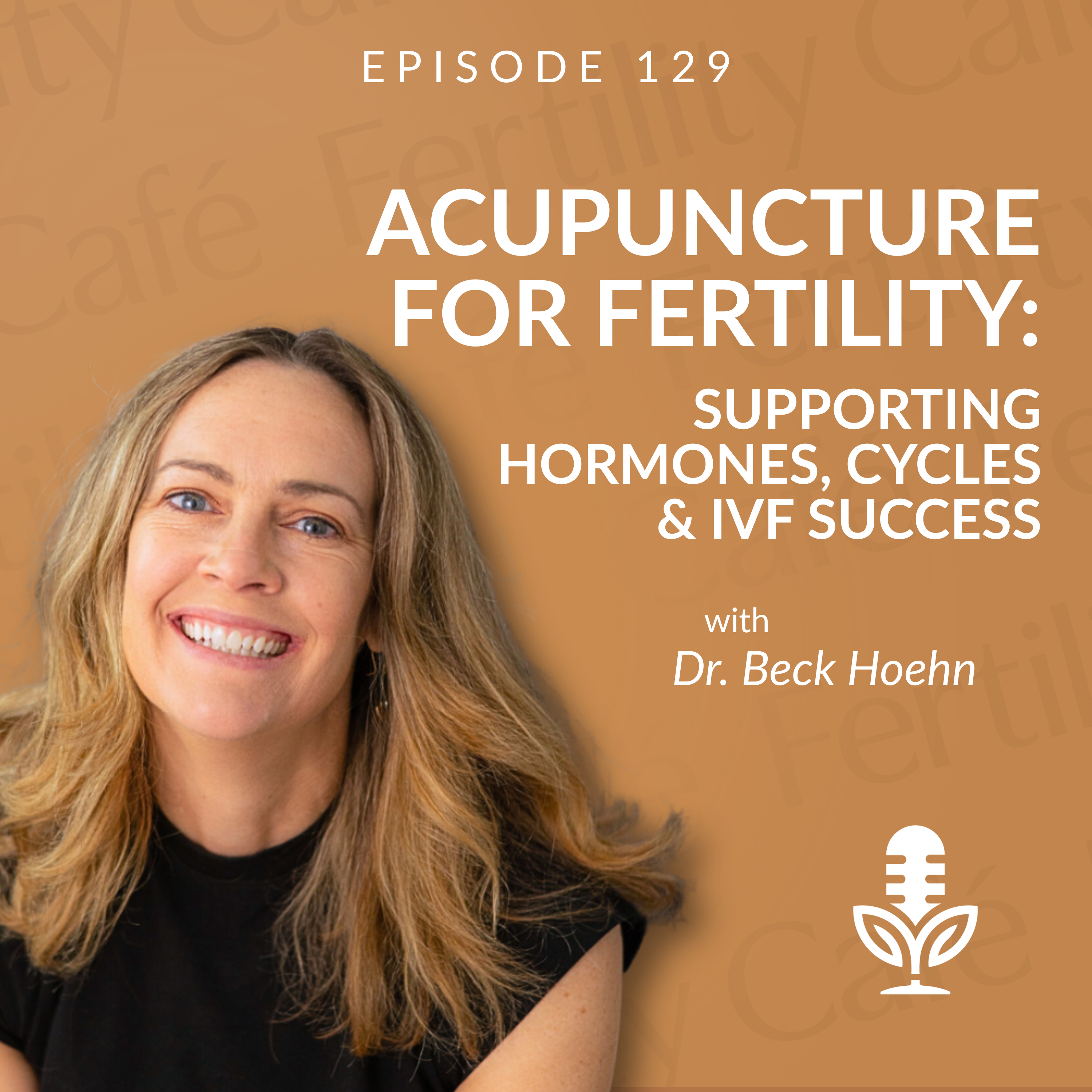
Episode Transcript
[00:00:00] Speaker A: Welcome to the Fertility Cafe, where we explore the beautiful complexity of modern family building.
I'm your host, Eloise Drain, and this is a space for honest conversations about surrogacy, egg donation and the journey to parenthood. With expert insights and real stories, we're here to guide you through the medical, legal and emotional aspects of third party family building.
We believe that love has no limits and neither should parenth.
[00:00:35] Speaker B: Well, Beck, thank you for joining me. I appreciate it.
[00:00:38] Speaker C: Thank you so much for having me here. This has been a really long journey for us to get together, but I'm excited to share with your community.
[00:00:45] Speaker B: Yes, I know we're here, so let's start really from the beginning. So how did you get into acupuncture, specifically in reproductive health?
[00:00:55] Speaker C: My background is in film and photography and I was in the camera guild for 25 years. And so during that time, I fell out of a crane, I got INJ at work, and the one thing that got me back on my feet was acupuncture. And in that time and in that moment, my mentor, who was the acupuncturist at the time, also fixed my painful periods. Like, it was just really this transformational turning point in my life where I was back to work.
I didn't have painful periods anymore and I was like ready to go again. Which is really important if you're in the film business. Right. Because it's just like you're body is your business basically. Not in a prostitute way, but just like it's very physically demanding. Right. And so what I was finding at the time was also because I was a female in the film working business, that a lot of my sisters in the union were also having painful periods and suffering from this. And I was like, this isn't right and it's not fair. And like, so I went back to acupuncture school and then I got additional degrees in fertility and reproductive health and also a doctorate in fertility and research because I felt like I needed to be able to support my camera sisters. Right. At the time, it was like I needed to be able to serve my community where they were in a place where they just didn't feel educated and empowered around having choice around the alternatives for getting better and for healing themselves and not knowing about, like, painful periods. Nobody should have to feel that way. Right. Like, we should really try to, like, workshop this together and not throw medicine at it. Good comment there. Yes. And not just go on the pill. Right. Like, there was a lot of that. So since then I've been really working in the TCC trying to conceive space for about 10 years now. And now I've just started to work on a container of perimenopause. So that's like my big, big research thing. I'm working on a lot of curriculum for that right now. Just kind of really trying to support people on the other end of their journey, so to speak.
[00:02:54] Speaker B: Yeah, it's more than treating more than just fertility, but you've also treated things like stress and digestion and hormone imbalances. And I don't necessarily think that people connect those things to reproductive health.
[00:03:07] Speaker C: Yeah, it's almost like a triangle. Right. Like, reproductive health is almost at the apex, and we have all of these foundational things that create and support that fertile field, that area that is our fertility and our reproductive health. And so stress and digestive issues definitely play into that completely, which was why those became kind of like pet projects. Right. When you're trying to conceive, you're kind of almost setting the person up to climb, I always say, Mount Kilimanjaro and do a marathon on it. Right. Like, it's just like you are getting ready to, like, go on the biggest physical health experience of your life. Right. We need to have you and your partner in the best shape that you've ever, actually ever realized that you could be. That's transformational. Right.
[00:03:55] Speaker B: When someone is going through IVF or iui, what kind of support can acupuncture then offer them during that process? Because when you think of, you know, going the fertility route, no one is thinking about acupuncture, and no one is putting together, Like, either you have to pick the Western medicine or you pick something more holistic. Like, it can't be something that's combined and joined forces.
[00:04:25] Speaker C: Yeah, that's a common belief. I will talk about that a little bit. Or, like, right now, acupuncture is really having, like, its own heyday, kind of as IVF support. So I'm super glad you asked this question. We're finding a lot of evidence now that is showing us in the research that when you do acupuncture in conjunction with ivf, it can improve the outcome considerably. Right. So there's a couple of pieces here. So, like, the first piece is really working on improving that follicular environment, Right. That environment around the egg cell as it's. As it starts developing during the retrieval process. And we have a really classic study. Everybody talks about it. It's called Steiner Victorin. And in this study, it was really interesting, actually. They did, like, a TENS unit on acupuncture points on the lower limbs and in conjunction with some place where the ovaries would be. And they found that they actually measured the flow rate of the blood flow through the femoral artery and before and after they administered the treatment. And they found that it got better, right? And it improved with the treatment, which shows us that that got better blood flow to that follicular environment. And that's obviously really, really beneficial to anyone. Right. Like that is going, undergoing that retrieval process.
So we have kind of things like that that are showing us that acupuncture can regulate the nervous system, work on that, regulating that cortisol response, work on better blood flow to the reproductive tract. And so those are all really powerful things. Right. Like there's two kind of concepts with acupuncture, right. In conjunction with IVF and iui. Right. So there's the prep work that goes up to the. The procedure itself, and then there's the in the moment. That's when we do acupuncture before and after a transfer, which is really interesting because we know that that can improve the efficacy of the transfer considerably.
So there's kind of like two pieces to the puzzle that can really help support that process.
[00:06:27] Speaker B: Well, and it's funny you say that, because when I did my second surrogacy journey, the intended mother and I both did acupuncture. She obviously did the acupuncture because they needed to do round of egg retrieval. So she went through her surgery side of doing acupuncture, and then I went on my side of doing acupuncture. That's before and after the transfer. You know, sometimes I think people, they hear IVF and they think that IVF is just this one silo thing. And trying to explain to people that IVF isn't a one piece. There's several pieces to ivf. IVF is when you're going through that creation of the eggs and then doing that retrieval and then the actual transfer of the embryos. And literally both myself and my intended mother had separate experiences, but still did acupuncture. And it was successful, by the way, just as an FYI.
[00:07:21] Speaker C: So there you go.
[00:07:23] Speaker B: Can you walk us through what someone's first visit would look like, like, from start to finish?
[00:07:29] Speaker C: Yeah. So it just depends where they are in their process. And they're trying to conceive process their health path. I think that it's, like, really interesting to think about people on this, like, health continuum.
I think about, like, my own all the time and, like, how it's ever evolving and albeit I have self awareness around self care, like my exposure to it is not that great. So but we, but we try to get them into like a whole health context. Right. So it's just like there's a lot of education and setup that I almost think of it like that relationship is like a three part proprietary process. In the first couple of stages of the engagement with a patient, we're really doing a lot of like data recovery and a lot of noticing around where they are with their stress management and their stress coping, maybe with their food, like how that looks. And then we're getting all of that data together and then we're moving them to the next tile which is kind of like educating them so that we can empower. Right. So the, the education piece is like, okay, here's. We've evaluated the data, here is like what we've found. These are the findings. This is around treatment like four or five and then we execute on that plan. Right. So we like deploy a treatment plan that we can both be on board with. When you have a relationship with a reproductive health acupuncturist, that's kind of what that ARC looks like. That's what that treatment ARC is going to look like. Coming to that first visit, it's really amazing. If you have some meal tracking done, if you have like your supplementation list also setting your intention, right. Like what do you want to get out of this relationship? It's not going to just be one person doing the heavy lifting.
We're going to be doing this as a collaboration for a long period of time, just being really punched in that this is not like you're not just going to jump off the needles and be pregnant.
Right.
[00:09:23] Speaker B: That doesn't happen. I mean, so how long though does it realistically would it take for someone to really be prepared? As much as you can prepare, obviously, but prepared to say, okay, I am now ready to begin my treatment.
[00:09:39] Speaker C: Yeah. And so that also depends on who you talk to. Right. We try to like preface this response with like trying to meet the person where they're at and trying to really like create context and realistic expectations for that person, like depending on where they are. Right. So we have people all the time for IVF support that come into the office and they're like, my retrieval is next week, like, hey, throw me a solid. Okay. Yeah. I mean we can still do things, but you know, if you stay with this for longer, you're gonna get a better result. Right. So generally speaking we say we see People for like three months, ideally right before they're actually gonna start a procedure, a process, or even during their TCC journey. A lot of times it takes a couple of months to really see the patterns come out and really get to know the patient on this level where you're able to support them initially and then make adjustments when you need to.
[00:10:34] Speaker B: For someone that is, you know, trying to conceive, are they informing their reproductive endocrinologist that, hey, I'm doing acupuncture, Is it going to affect something? Is it going to change something? What is, what would happen with the medication? Does it happen or does anything happen to the medication? Can you talk about that?
[00:10:54] Speaker C: It's a great question too. So our office is different, right? Mighty River Wellness is different, right? We have like these great relationships with all these reproductive endocrine endocrinologists. Like we've got them on the phone all the time. We can be like, hey, how are you doing? This is happening with this patient. That's like one of the powers of being established in the field for like a while and that's like our local reputation, but for people in Atlanta or like in your community. One thing I would definitely stay in contact with the reproductive endocrinologist and say, like, yes, I'm doing. Having a dialogue about who you're collaborating with is always really important. Checking in with them a lot of times. There's not a lot of evidence based research around IVF support and herbology, sadly, which is another spoke of our medicine. Our office personally does not do herbs during the IVF process because some of those herbs are really powerful. We don't have enough research on like what the estrogenic effect is going to be. And like, really honestly, like, we want the re to have as much controlling as many variables as possible with the acupuncture. It's a little different. Like we know for a fact that like, we do have this evidence based, like research that is showing us that if we do these specific, specific points or this protocol, we're going to have this kind of general effect. Not to say everyone's not different, but just that the numbers are, are really there for acupuncture alone.
[00:12:17] Speaker B: So can we actually talk about the herbal medicine and how that all fits into the process for patients?
[00:12:22] Speaker C: Totally. Hold my beer.
Um, I love herbs. They're so lovely. So in Eastern philosophy, in our medicine, traditional Eastern Asian medicine is teams. This is like the current vernacular. We have all of these really interesting spokes that umbrella, right? So we have acupuncture, we have Herbs, we have tweena and gua sha, which are kind of more of those manual therapies. And then we have warming therapy, which is called moxibustion.
So we kind of use these all together in this really synergistic model where they all kind of complement each other, right?
So the acupuncture is going to be one treatment plan, right? And so that point selection in that acupuncture protocol for that patient is going to have a different range of action and effect.
Then the herbs are this powerful. It's like the left hand of this medicine, right? So it's like salt and pepper, these like complimentary lock and key models where the herbs can really move the needle in the times when the person's not at an acupuncture visit.
So they can have that profound effect. If the, the acupuncturist and the herbalist is, okay, this is the point selection that I'm doing. And then I'm going to complement that with that same kind of treatment plan in the herbal medicine. So the herbs are really interesting because the herbs in our materia medica, which is our, like, complete and total library of all of our herbs, work in synergy, again, also that synergy, that complementary medicine, all together to really support the body healing itself.
[00:13:59] Speaker B: So how do you track, though? How do you track to see if these, with the acupuncture and the herbal medicine and all of that, that it's actually working from session to session because you said it takes a while.
So how do you see, is it really going to make a difference? Am I wasting my time?
[00:14:17] Speaker C: Like, what do you do for the TCC naturally space, like the natural TCC space? It's really interesting. Like, I'm on the medical advisory board for a company called oova, right? Which is. It tests hormones as they're represented in urine.
And this can be a really accurate way to show the acupuncturist and collaborate with the acupuncturist. It's a graphic representation of what your hormones are doing in the follicular phase relative to the luteal phase. And you can actually see those graphs improve over time, right? Which is really powerful. The other cool thing about that technology, which is like, why we want to use that TCM pattern differentiation along with something like that, which is a data tracking tool, it creates a collaboration between the patient and the acupuncturist. And we're able to make interventions on a dime, right? So, like, we're able to make adjustments and interventions to really support the patient really easily.
So that's like one way that you can track PCM is really like actually more symptom based. Right. So we can actually ask the right questions at the intake and then see, like, okay, that's how we measure that outcome. So like around treatment three to five, we're going to do an assessment and be like, hey, are you sleeping better?
Yes. The answer is always yes. Right. Are you moving better? Is your digestion better? Like, all of these tiny ways that the body's just inherently innately improving is just really amazing to see.
Yeah.
[00:15:47] Speaker B: And I know we've been talking about IVF and fertility and all of that, but I definitely want to jump back to these painful periods. And not just using acupuncture because you're trying to conceive, but also looking at acupuncture for, you know, again, a lot of people love to tell them this is my issue and the first thing they want to do is throw medication at it. But for these painful periods. And you, you know, talked about your own experience because quite honestly, until you and I spoke, I never thought about utilizing acupuncture for painful periods.
[00:16:22] Speaker C: That's like the one thing that people say every time, every time they come into our office and like, they don't even realize that it's going to be like, make their period so much better. And it's like crazy how like transformational that can be. Like, you see that in four visits of just acupuncture. So just imagine, like in one cycle you're able to really turn somebody's life around, you know, unless it's like, obviously there's connect, there's exceptions to the rule. Right. But like, the first thing, like the first cycle and experience at our office generally is like, holy crap, I didn't have any cramps this time. Or I noticed that my blood flow, like my clots weren't as, as huge. And that's like where there's two powerful things there. Right. So also, we teach at our office, we teach people acupressure as part of their experience. So they're doing the acupuncture at our office pretty like three times a week, pretty aggressively, right along certain points on the inner lower legs that can really help with painful periods. And then in conjunction with that, obviously, like, we're probably doing some herbs to support them.
[00:17:34] Speaker B: Right.
[00:17:35] Speaker C: So those herbs can be really powerful in regulating that system for so many.
[00:17:40] Speaker B: People obviously, that they have these problems. When do they come to you? Okay, I've been having these heavy periods. Am I going to start At a random time. Do we start when I'm on my period? How does it actually work?
[00:17:53] Speaker C: I would just say if you're listening to this show and you have painful periods, go to the acupuncturist as soon as possible.
Don't press, don't think about it.
[00:18:03] Speaker B: Yeah, just go.
[00:18:04] Speaker C: Just go and like go to a specialist. Right? Like, this is the thing is, like, there's a cool board called the ABOR board and they are a national certification. And those people, you have to like, go to extra training and like get a specialty in that niche. It's such a cool time for acupuncture as well, because we have these generalists which are like these powerful doctors in and of itself. They're able to like, deal with whatever comes across their patient load that day. Who does that? That's incredible. But then there's also these people like me where it's like, for the longest time, I'll just be honest, like, I was kind of a one trick pony. Like, I'm like, oh, I can make a baby. Okay, cool. I can like work on painful periods. And it's like, if you have painful periods or you're doing anything, reproductive health, make sure that you're interviewing that doctor. Make sure that you have that relationship before you get to the office and like, make sure that they have that extra certification.
[00:18:59] Speaker B: And I was going to ask, how does someone even go about looking for an acupuncture that, you know, specializes not just fertility care, but reproductive health?
[00:19:08] Speaker C: That's your answer is like, they are doing such a great job. Here's the thing is being an acupuncturist is like, I don't know what it's like in Georgia, but I know in California it's like, I don't know, I feel like I've just given my like, left kidney to do all that training. Right. Like, I got my doctorate in 2022 and you know, that was a long time ago and like, I'm still coming out of the haze of PTSD of those people, like making sure that they have that extra specialty as like a, a huge deal for you. Like, you'll feel really entrusted. I mean, you can entrust them when you care.
[00:19:43] Speaker B: Yeah, yeah, for sure. So can you give us an example of, let's say, someone who has low ovarian reserve? Right. And they are trying to figure out everything they can possibly do in order to help get better quality eggs so that they can have better outcomes.
What would your suggestion be?
[00:20:06] Speaker C: For sure? Like, commit to at least three to Six months of acupuncture. Right. Making sure that you're really working on your supplementation, working on your nutrition, making sure that that acupuncturist is really in a dialogue with you about that. And then things like tens unit at home even can be really powerful. Again, we talked at the top of this conversation around Steiner Victorin. Getting better blood flow to that follicular can be really powerful in and of itself. Doing things like abdominal massage can be great. Things like Mercier therapy and our Vigo in conjunction with what you're doing with the acupuncturist and the herbalist can always be really great too. We have this thing called Jing preservation. Like thinking about supporting that kidney essence, which is your constitutional essence, is one of the key components to supporting your fertility. Working with an acupuncturist can really help that with those numbers a lot.
[00:21:06] Speaker B: So you mentioned about supplements and things like that. What kind of supplements?
[00:21:11] Speaker C: Well, there's a lot of supplementation that you can highlight. It's really definitely dependent on the person. Like I wouldn't like just randomly run to Amazon and buy something off the Internet. Like I would definitely be with a provider that like knew how to custom tailor the right supplements for you. I will say this about Amazon. Like do not buy things off Amazon. Make sure that you know somebody that's like using fullscript, like, okay, there's those standards on. There are. That's prosumer quality. And like make sure that you're not just wasting your money and buying something off of Amazon that's not vetted and like gone through those rigorous testing standards that FullScript does. Right. And making sure that you have a provider that knows the current data and like all of that research. When you're going through that, can you.
[00:22:00] Speaker B: Give us an example of a client or a patient that has had issues, let's say ovarian, low ovarian reserve. And what a scenario of what happened at our office.
[00:22:10] Speaker C: I'm only speaking of my office, not my, my profession completely. But at our office last year it was like miracles do come true. All of these patients that were like over 40 that were having these like insane results.
So we had like a 55 year old give birth this past year that was through a donor situation, but she carried, which was incredible, had this beautiful, amazing pregnancy, amazing birthday, which was great. And then this year it's been weird. Like this current theme is people with low ovarian reserve at like in the beginning of the quarter. I'm pretty pro IVF in the terms of let's make sure that we're using the advantage of time for these people and like, making sure that they're getting with a doctor that they can trust and through that framework, if they need to, you know, preserve some embryos, like, freeze fast, think later. Right? Like, that's kind of my thing for these low adventure and reserve people. At the beginning of the year, I was like, okay, guys, we're gonna give it this much amount of time. You can try to conceive naturally. But I'm gonna send you over to my, my buddy. They would like, they were literally at the three month mark, they were like, okay, yeah, this next cycle we're just gonna have our period and start with the person you recommended. And then they were like on their way to like waiting for their period and they got pregnant. Oh, this was all. This was like a weirdo march.
I don't know what happened.
[00:23:35] Speaker B: So let's just put that out in the air for everybody.
[00:23:37] Speaker C: It is every. It should be in the air for everyone. Yeah. I'm from the east coast, so I have this provincial pessimist. I'm pretty skeptical of acupuncture, albeit it like got me back on my feet and everything.
So when stuff like this happens and it's like truly is. Feels like a miracle from Disneyland, I'm like, what happened? Like, and that's for me, like practicing 12 years, you know, like, I'm still amazed.
[00:24:04] Speaker B: Yeah, no, I mean, it's amazing.
Would it be also helpful for people that have fibroids and pcos and endometriosis and all of the other painful things that unfortunately women have to go through that people are finally starting to have conversations about?
[00:24:24] Speaker C: Yeah, for sure. Each one of those conditions have like a different range of action of like, treatment strategy. The interesting one is, you know, I, I think, you know, probably 31% of the American population has some sort of genetic expression of pcos. That is where acupuncturists are really powerful. Right. Because a lot of a western intervention container or framework or inter. Dr. Doesn't really know about anything besides the main, like more popular expression of that pcos. And so an acupuncturist is really like a detective when it comes to that. Right. And so they're able to kind of ferret that out in a way of like, okay, yeah, your labs are fine, but you're feeling like crap and you're like, maybe you're not overweight and you're still ovulatory, but like, something feels off. Right. So an acupuncturist is going to hear you in that moment and really support you in your care. And then with endo, you know, we know for a fact that acupuncture is really great for pain management. Right. Because been now under the umbrella of Medicare because of. In response to the opioid crisis, we have used. Now acupuncture is a covered benefit for pain management.
So this is just like, once we get into this direct pain management, the major pairs are going to start coming over the line for acupuncture being used for a wider spectrum of conditions. I got off topic there for a second. But just to say is like, people say, see a reduction in pain with endometriosis conditions and using acupuncture. One thing I do say about fibroids is like, make sure that you are in massive dialogue with your primary care or your OB or whatever. You're really monitoring and watching that. It just depends where the fibroid is really in terms of what intervention you want to do and where you are in your journey. I would say just tread lightly there. Like, make sure that you're like, really in collaboration with somebody that's like, really watching it and monitoring that. That.
[00:26:24] Speaker B: Yeah. Just knowing, though, that there are other options besides I have to jump to medication, I have to jump to surgery. There's other options that can actually be utilized first. It's refreshing, to be honest.
[00:26:38] Speaker C: Yeah.
[00:26:39] Speaker B: Because I can tell you wasn't no one telling me about utilizing acupuncture when I had painful periods. So unfortunately, it was just not a conversation.
[00:26:48] Speaker C: Yeah. I'm so sorry for you. I had the. Actually the same experience until I, like, I got injured at work and almost broke my back.
That was what it took. But I will say this, like, you and I come from a really interesting generation. Right. I remember my mom. My mom had like, massive, horrible periods forever. And she was just like. When I started cycling, she was like, this is just how it is. This is it.
I was told forever, like, just take an Advil and go to work. Like, you cannot miss a day of work. Work for this thing. Right?
And now it's just like, you. You start learning. Like, that's not the narrative I want to lead with. Right. Like, granted, obviously, I want you all to go to work and have perfect attendance, but I also want you to find an acupuncturist and try to, like, work with them to see if you can get better. Right.
[00:27:39] Speaker B: I mean, we're talking about periods and all that, but, you know, obviously life transitions and now it's Menopause. And not that I'm trying to tell my business, but here we are. I'm. I am now fledged in menopause, and I don't want to do HRT and. And I don't want to do it, not because I think there's anything wrong with it, but because of the fact that I've been an egg donor many times and I've been a surrogate many times. In total, I've had 13 rounds of IVF in some form of fashion.
I do not want to put any more hormones into my body at this point. And then I also had to have a hysterectomy.
And again, I don't want to put any more hormones into my body. And so when I go to the doctor and I'm telling them, okay, I can't sleep. I don't want to take more medication because I can't sleep. I'm having hot flashes. I don't want to take HRT because of hot flashes.
[00:28:33] Speaker C: I'm.
[00:28:34] Speaker B: Whatever. No, I don't want to use pellets. No, I don't want to use patches. No, I don't.
What else is there?
[00:28:40] Speaker C: Yeah, so, like, HRT has its place, right? Like, I'm not going to, like, poo poo it. Like, again, just, like, have this dialogue, put your provider's feet to the fire, get a second opinion, like, and also, acupuncture works so powerfully for the moments in the hot flashes. In all of these things, we have lovely, lovely formulas for this, like, TCM formulas that can be such a great intervention for, like, that are like, I can name five off of the top of my head that are just really incredible. So, like, don't poo poo herbal medicine in this moment. And, like, like, there might be a moment too, like, where you want to do some deeper dive diagnostics. Maybe you want to find an herbalist and an acupuncturist who also studies functional medicine and can really give you a clear picture of what your hormones are doing. Like, here's a starting point benchmark, like, with something like, there's a lab called Precision Analytical, and they do a Dutch complete, which is like, really great test. And so it's like, okay, cool, that's. This is where I am now. And. And this is like, you can test again. And like, okay, this is where I am after the intervention or whatever that is. So beyond the pellets, beyond the hrt, like, there are these other things that can. We want you to land in menopause, which is why I'm Studying perimenopause right now is like, we want this transition to be like having you land on a light pillow, not like we're pushing you in direct traffic.
[00:30:07] Speaker B: That would be so wonderful.
[00:30:09] Speaker C: And it really does come down to, like, it's really funny. My population is very. It's such a cool population to study. Like, my demographic is like, I'm really close to all the studios, right? So it's like I'm really close to Studio City and Universal and, and Disney and all of these really incredible, talented, very well spoken, intelligent women are coming in with extreme hot flashes. Extreme, like, because their jobs are so stressful, right? Like, stress is really like driving all of that. That those symptoms. And so going in and getting an acupuncture treatment once a week to like work on your stress and coping management and helping you regulate that cortisol is like amazing for them and curious too.
[00:30:56] Speaker B: Do people also do acupuncture during pregnancy?
[00:30:59] Speaker C: For sure, yeah. Yeah, for sure. So I usually see like, let's see. So we've got like five or six pregnancy ladies right now. So we usually see them. And this is going to be different for every office, right?
Once you conceive at our office, we see you through that first trimester, which is like so powerful, right? So we do things to what's called calm the fetus. And this is an ancient way of saying, like getting more blood flow to the uterus. So the embryo is like, wants to stay there. We do a couple of what are called distal points, which are points away from the area, and then local points, which are points that are like right on the area. Right. So we balance those out distal and local points, and we see those people and it can be massively helpful for nausea and vomiting, like morning sickness. Right. I usually see people like until week 12. And then I'm like, hey, how you doing? Come on in. If you have that, you know that carpal tunnel that you can get for pregnancy, that constipation, a lot of times that acid regurgit, sadly, like starts to kind of rear its ugly head. So that can be really helpful as well.
[00:32:01] Speaker B: Okay. I know we are coming up on time, but I definitely wanted to make sure that people knew that there are additional helpful things that are out there that can be working in conjunction with all of the other things that you're doing to either conceive or to replace medications for whatever you need.
[00:32:24] Speaker C: And for those of you guys that are not local to la, my team and I have created the Make a baby bundle, which is great. It's all about. It's like a little primer that you can listen to in the car. It's a mini course about optimizing sperm and eg, health. It's a great little tool. Like, okay, this is a cool starting point. So we've seen a lot of success with that too.
[00:32:45] Speaker B: Perfect. Where can people find you?
[00:32:47] Speaker C: Yeah. So on my website, generally speaking is Mighty River Wellness. And then we also have Instagram and Tik Tok and all of those things as well at Dr. Beck Cohen. We look forward to hearing from your community. This has been really great.
[00:33:01] Speaker B: Yeah.
[00:33:02] Speaker C: Awesome.
[00:33:02] Speaker B: Well, we'll make sure everything is in the show notes. Anyway, so back. Thank you so much for joining me. I really appreciate it.
[00:33:09] Speaker C: Totally. It was so nice chitchatting with you as well. I really appreciate you allowing me to share with your community.
[00:33:17] Speaker B: Absolutely. Yes. And like I said, we'll. We'll talk on the other side.
[00:33:22] Speaker C: Talk on the other side.