Episode Transcript
[00:00:00] Speaker A: Lately, more and more people around the world are looking to the US when it comes to fertility treatment and surrogacy. And honestly, there isn't just one reason for that. For some, it might be about having more options. For others, it could be the ability to work with a clinic or agency that's really experienced. But a lot of the time, it's because the laws in their own country won't actually allow them to pursue surrogacy at all.
So they're left with no choice but to look elsewhere. And honestly, there isn't just one reason for that. For some, it might be about having more options. For others, it could be the ability to work with a clinic or agency that's really experienced. But a lot of the time, it's because the laws in their own country won't actually allow them to pursue surrogacy at all. So they're left with no choice but to look elsewhere. And when they do, the US Often stands out as one of the best and in many cases, the most secure option available anywhere in the world. And now, that doesn't mean the US process is simple. It's not. There's a lot to figure out. From legal steps to medical logistics, to navigating the emotional side of everything. It's a lot to manage, especially when you're doing it from another country and trying to get it all right. Welcome to the Fertility Cafe, where we explore the beautiful complexity of modern family building.
I'm your host, Eloise Drain, and this is a space for honest conversations about surrogacy, egg donation and the journey to parenth.
With expert insights and real stories, we're here to guide you through the medical, legal and emotional aspects of third party family building.
We believe that love has no limits, and neither should parenthood.
Welcome back to Fertility Cafe. I'm your host, Eloise Drain. When people start looking into surrogacy in the US from another country, it usually doesn't take long before the questions start piling up. There's the legal side, like how parentage works, what kind of paperwork is involved, and what happens after the baby is born. Then there's the logistics. How to find the right agency or clinic, how to communicate across time zones, how to manage appointments, and what kind of support systems are actually in place. And of course, there's the emotional side. Because this isn't just a transaction, it's a major life step.
There's a lot that intended parents are trying to make sense of. And honestly, it's not always clear where to turn for answers that's why I wanted to bring in someone who really understands what it means to go through this process, not just once, but to keep showing up for others who are walking the same path.
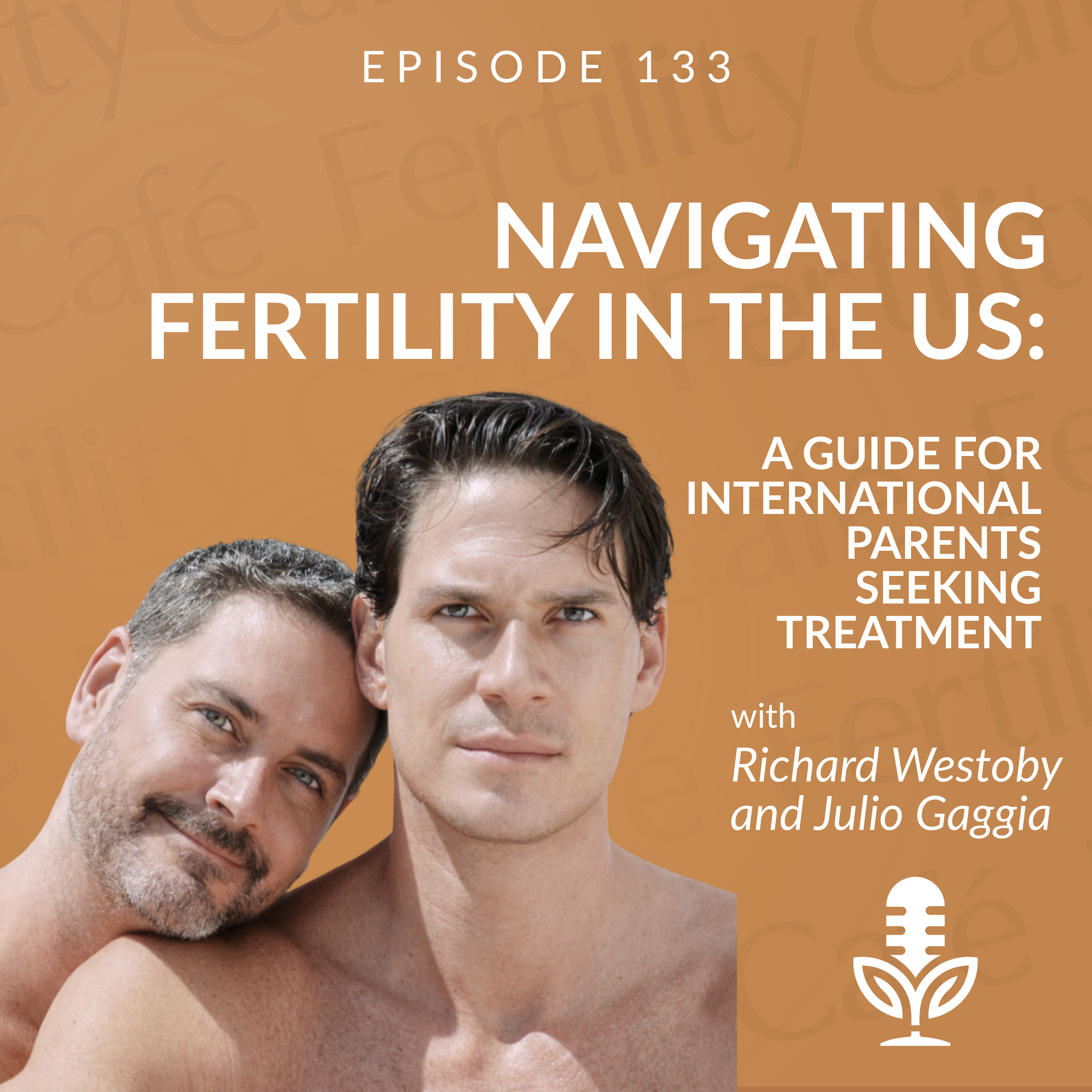
Richard Westaby is the co founder of IVF Daddies, which started with his own journey to parenthood.
Over time, that journey opened the door to a whole community of people navigating surrogacy and family building from all kinds of angles. And now, alongside his partner Julio, Richard helped shine a light on the questions, the challenges and the real life experiences that so many international parents are dealing with, Especially the ones they're not always sure how to ask out loud. Richard, Julio, thank you for joining me. I appreciate you guys being here. Hello.
[00:03:17] Speaker B: Hello. Thank you for having us.
[00:03:20] Speaker A: Let's get started. Walk us through your journey of parenthood because I know what it led for you to pursue surrogacy in the us, but a lot of people don't necessarily understand, especially when you're talking about international.
What was your story?
[00:03:33] Speaker C: How did we get here? Great question. So I, alongside my ex husband about 14 years ago, decided that we wanted to have children and living in England, it was a bit complicated, so we didn't really understand in the UK at the time you really didn't go through the surrogacy process. He's an American.
So we reached out to some friends and we ended up going down the US route.
Now obviously you have lots of different search engines, there's a plethora of information out there, but at the time there really wasn't. So it was very much I took the reins, I kind of led the charge on getting the information, trying to see what we were doing, how we could do it, how best to do it with the little information that was available. And that led to I've got boygirl twins who are going to be 13 next month. Really led to a very sharp changing career for me because I used to work in finance and I stopped doing that. I wrote a book on surrogacy and then kind of became a bit of a guru on helping people to understand from an international perspective how do you go about doing this in the us and then three years ago I met him. So by that stage I was single and was raising children. We met in Spain because I've moved to Spain temporarily and I was like, hi, I have twins. And he was like, great.
And here we are three years later. So he's taken on the role very much of being almost the third dad in their relationship and it works really well. Obviously there are always Ups and downs. And I think it's a tightrope for anybody who's joining a ready made family. But he, you know, he's doing a good job.
[00:05:11] Speaker A: Yeah, yeah, yeah. And he's cute too, so that helps.
[00:05:15] Speaker C: It helps a lot. Yeah.
[00:05:17] Speaker B: Well, from my perspective, it's like, I feel like Richard was like a bright Scylla trying to get like a binder with like all the wedding planning and then he made it into a book. And then when I joined in, it's just like walking the tightrope in the mountain Everest. If you think being a dad is easy, try to be a step parent in the gay. That's no reference or representation or support system.
But I've grew up with divorces in my family, so my dad has kids and my brother also has two kids. They're the same age as our kids. And now I cannot not say that there are kids. Actually, the best example was when we went to Father's Day, the three of us, the three dads with the kids. And the three of us got a letter of Father's Day that was really unexpected.
[00:06:10] Speaker A: That's awesome.
[00:06:11] Speaker C: Yeah. I'm Tom Selleck. Three dads and a little baby. Yes, I'll be Tom SELLECK.
[00:06:16] Speaker A: And obviously 14 years ago, you know, everybody was still using Dr. Google. We had, we hadn't moved to ChatGPT yet. What was the biggest challenges that you were navigating, as you know, and facing as the process was moving forward with international surrogacy and then also being gay dads?
[00:06:37] Speaker C: Well, I think the reality is, unfortunately the navigation of the challenges is pretty much the same now as it was then. It's this transparency wasn't there. It was understanding the implications of the decisions that you take. Because you can think about a decision tree, right? You start with one and then you take a left or right fork and then all of a sudden you end up somewhere completely different.
And that was really the impetus behind doing what we're doing. What writing the book and now obviously having podcasts and all these things is getting that information out there. Because there was no transparency. It was will tell you when you need to know. That for me was really, really challenging because as a gay man 14 years ago, it was a very different world. So we were battling that. And then it was the, oh, well, you're going to be dads. What does that. How what? Huh? So there was that and then trying to get the information was very, very difficult. People as well. And I think it's almost the pendulum has swung a little Bit it's like from a lack of information to almost too much information now. And the problem now is with chat GPT, for example, is you can synthesize the information, but it's only looking at what's out there. It's not saying, hey, this information is good, this information is bad. It's just saying, here is the information, right? So beforehand, the. The lack of transparency meant that were we as protected as we could have been, probably not.
Now it's the same. There's too much information. So you can be protected or not protected, depending on which fork you take because you listen to the wrong person.
[00:08:16] Speaker B: This is when I get, like, completely lost in the reason that I created the podcast.
[00:08:20] Speaker C: Whatever.
[00:08:21] Speaker B: It's like I zoned out.
[00:08:23] Speaker C: Welcome to our relationship.
[00:08:25] Speaker B: And the funny thing is when he says that there was no information and now there's too much information.
Like, the questions that you hear are like, do I still have to sleep with the surrogate? It's just like, can I get the colors of the baby? Because for him it's obvious. For me it's like, this is not obvious.
Also, like, when people comment on the podcast, anything negative, all I can say is, you're absolutely right. I wish you never had to go through alternative options. But in reality, as some people get to this point and when it's the.
[00:08:56] Speaker A: Last resource, what do you wish you had known before starting the process?
[00:09:01] Speaker B: We want to have a family. And what I wish it would have happened before is not be so focused on being so heteronormative so the kids are accepted that we're like, you can revoke or gay card if you want tomorrow.
[00:09:17] Speaker A: But what from your experience makes the surrogacy system stand out in the US Then?
[00:09:22] Speaker C: So for me, I think being able to give people the ups and the downs of what I went through, to be able to help them to navigate that, that really I find very validating to be able to be. To say to someone, hey, hey, before you make these decisions, like, just, let's just think it through.
Whereas he's a lot more, okay, let's disrupt the system. Let's figure out how to do this so that everybody can do it. Because it's not fair that you have to be rich to be able to have this and. And valid. So. But I think we come at it from very, very different perspectives.
[00:09:55] Speaker B: Or, for example, like, I'm Italian, and if I want to have a kid, I can get fined a million, a million euros. And I admit my last name can. My name can be removed from the certificate, because I have an Italian passport.
So how do we go from coming home from a baby or getting stuck in a country for extra six months or just like, not having a baby, just having hope.
[00:10:21] Speaker A: So then let's talk about then, what are some of the reasons why, you know, people start looking, doing surrogacy outside beyond their home country?
[00:10:29] Speaker B: It's cost. It's like, when you start here in the Argentina, it's cheaper. The Mexico is not legal, but it's not illegal. We have a story of somebody in our podcast that had the kids in India, and then she did all the research in the world, but she got stuck, like, longer than she should. And then she had the second kid in Canada thinking that Canada is like, you know, squeaky clean, hunky dory, super legal. So she didn't do any research. And it was a travesty. The concept is like, stalk your agency like an ex boyfriend on Instagram. Like, and if the caption does not match the photo.
[00:11:10] Speaker A: Yes, yes, 100%. Because, I mean, let's just look at the agency that has had how many babies that the FBI is involved. Mark Surrogacy.
[00:11:22] Speaker C: I think that there are two parts to this. And I think what Julio has just hit on is why do people come to the United States? When you look at the global industry, the US Is where you're the most protected in theory. Let's not talk about Mark surrogacy. But that is where, as an intended parent, you're on the birth certificate. It's a legal document where you as the parents are on there. But I think your question was slightly more tied to, okay, why do people have to think about going to the United States? So, for example, in Italy, if you're looking at surrogacy and you have a baby through surrogacy, you go back to Italy. The Italian government have made it a criminal offense, and they can fine you up to a million euros. Right. So any Italian looking at doing this has a problem. The Spanish government has recently reinterpreted a law that has been there for a long time to make it more difficult for people who've been through surrogacy. You can't do it in Germany. In France, you can do it in the United Kingdom, but you're not allowed to pay your surrogate, which brings a whole host of other issues of trust and is actually who's taking advantage? Is she being taken advantage of because she's doing it because she wants to? As you know, all of a sudden you have compensation that you're paying somebody to do this work.
[00:12:34] Speaker B: And also demand. And when you do it for altruism, is that demand versus the amount of people?
[00:12:40] Speaker C: Yeah, the supply, demand.
[00:12:41] Speaker B: Supply, demand, yeah.
[00:12:43] Speaker C: And so what you have is when people look at the United States, it literally is a country where, you know, you have an agency, you have a lawyer, you have informed participants. Everybody goes through a psychological evaluation. You are legally informed, you have to sign contracts, you are represented. I have a great, great friend of mine who is vehemently anti surrogacy and because of the exploitation of women. And what's wonderful is we have this great debate, her and I, but we actually agree on that. We agree on the exploitation that shouldn't happen, but we disagree on different parts. Right. And I think that is where a lot of this conversation has to go is if you are a surrogate in the United States, are you being exploited or are you as a woman making informed choice to do your own body what you'd like to do? Which brings a whole host of other issues into the United States, which is.
[00:13:35] Speaker B: Why I come to the point of like intimacy and more humane and more listen to your God.
[00:13:40] Speaker A: What are the biggest concerns or hesitations? Then you hear from people who are considering doing surrogacy or even considering fertility care in the U.S. to your point, it's not straightforward. Client care has gone out the window over the years, not just women. You were talking earlier about how your friend was talking about women being exploited. But quite frankly, I feel like it's not just women that are being exploited. It's anybody that needs medical care is being exploited. We've all become commodities in this country, especially an international person where your medical care is probably very different than what we have here. But you have to come here in order to be able to do surrogacy. Like, what would your concerns be? What do you even think about to do that?
[00:14:29] Speaker B: I will make it controversial and then he will explain it more pragmatic and professional.
Like, it's almost like the medical industry rather work with inefficiency than innovation.
[00:14:39] Speaker A: We live in a reactive country and not a proactive country.
[00:14:43] Speaker B: Exactly. So you, the fact that you are a hostage of people that are just like check collectors and licensing. There's no evolution, there's no innovation, there's nothing moving forward. And then it becomes just like a system that like you're stuck with just avoiding liabilities. So you don't want to address anything that will make it better or cheaper or affordable. Like Greece, for example. Greece has something called at least women for women, which is you can be a surrogate for a woman, like that could be legal. Or if you're a lesbian couple in Spain, the other woman can carry the egg of the wife. So they are like steps in Europe that protect that with lower, like health care, lower prices. But in the US I would say the medication and the insurance, I think.
[00:15:31] Speaker C: The biggest hesitation there are two. One is understanding the medical system in the United States is, it's mind blowing for a lot of Europeans. So we have in England, in Spain, in France, we have health care that is paid for through our taxes, but it's paid for by the government. So you don't have to worry about, you know, he had an accident last year, was in hospital for five days, walked out with a piece of paper and no bill. That leads into the biggest concern. And it's always around money. And going through this process is so extraordinarily expensive that people look to cut corners. And this is what he was alluding to earlier. And you're, you're looking at the gold plated, you're looking at the United States, you're seeing the protection, you're seeing how this could work in an ideal world. And you sit there going, I can't afford that. My dream is to have a child and I can't afford it. And then someone comes from the sidelines and goes, but come over here, come to this country where you can do it for half the price.
And all of a sudden that risk tolerance that you have to being fully protected goes out the window because your dream is to have a baby. And I think for international people, that's really, really challenging. And then the third thing is when you have a baby in the United States, as somebody from abroad, you have to basically try and find an insurance policy to cover that baby once it's born. It's very, very difficult. It's small amount of companies that offer you that insurance, but that could be 30, 40, $50,000 and a totally unexpected.
[00:17:08] Speaker A: Cost on top of everything else you've.
[00:17:11] Speaker C: Already paid, on top of everything you've already spent.
[00:17:13] Speaker A: Yeah.
[00:17:14] Speaker C: And that scares a lot of people because the last thing you want to do is be in a situation where half pregnant, you run out of money.
[00:17:21] Speaker A: Yeah, yeah.
[00:17:23] Speaker B: But when you get surgery and you get treatment in the U.S.
the prices with insurance and without insurance are completely different.
[00:17:32] Speaker A: Because insurance and the medical care in this country has become a business. It's no longer about patient care, it's about revenue.
[00:17:40] Speaker B: When I lived in New York, I told my friends, they put me In a taxi. Do not get an ambulance because they will charge me €1,000. Thousand dollars. Because you did not request permission to your insurance.
[00:17:52] Speaker A: 100%.
So for someone who's considering this, then what would you encourage people to think about through when they're starting to explore US Surrogacy?
[00:18:05] Speaker C: I think they need to really understand the steps in the process. And I think your podcast does a lot. You've had many interviews, fantastic guests, us included, where you, you, you've gone through a lot of that. So it's building that education base of your own and that knowledge hub of your own to be able to say, this is the process and this is what I should be doing. Whether or not you know who you're going to be doing it with, that's a different story. But at least you know the steps in the process, right? And that was arguably why I wrote my book. Each chapter is a step in the process.
Once you've got that, you can then really talk to you or us and go, okay, this is what I'm thinking. Because the nuances, everybody's story is different. The process generally will be the same, but everybody's story is different.
And that can lead to. Got fertility benefits. Have you thought about that? Or. I had a somebody last year that changed companies because the fertility benefit where he moved to was double where he was.
Anybody looking at this just needs to really sit down with somebody agnostic, somebody who has no vested interest, somebody like us who's just sitting there going, we want to help to go, right? Step one, step two, step three.
[00:19:19] Speaker A: So for someone international, what does a typical surrogacy journey look like from them starting the contact to bringing the baby home? So they would have to start with, okay, first you need to decide that you want to do surrogacy in the US and are you creating your embryos in your home country? Shipping? Do you need to come here?
[00:19:39] Speaker C: Like, you need to find out legally if you can do it.
So in your home country, you need to talk to a lawyer in your home country to say, if I do this, how do I come home with this baby and be recognized as the parent to this child? Because can you imagine going through this whole process, spending all this money, all this emotion to then get home and the local government say, it's not your child. People looking at the United States, they're coming from, or anybody looking at surrogacy is coming from a different point. As a gay man, you're like, I want to have a child. How do I do it? You know that you have to go through surrogacy. If you were born without a uterus or you've had to have a hysterectomy or something, you know, that you can't carry, therefore you have to have a surrogate. There are lots of people who struggle with infertility and to his point, then have to grieve for the baby they never had and then think about, okay, what am I going to do next? And some make it to us, some make it to other people. However they make it, they're going to get to the point where they're like, this is the process I need to do. Now, some people have embryos already made, right? We can work with those in the United States as long as certain conditions are followed. For example, if you can't provide eggs anymore, say, for example, you had to have your ovaries removed and you have eggs frozen, they can be used. But if you still can produce eggs, we can't use eggs that were frozen before. You have to use what you're having now, right? So the FDA governs all of that. There are many different starting points to getting to having an embryo, be it using egg and sperm of a heterosexual couple, be it through an egg donor, through a sperm donor. However it is. But when people look at the process, they're going to go, okay, what do I need to do? And it really is as simple as sperm, eggs, uterus, right? We're going to start. I always say start with sperm because you've got to make sure that there is sperm. If there's no sperm, there's not going to be an embryo.
And frankly, going to do a sperm test is two minutes. It's non invasive. Off you go.
Every man should be doing a sperm test.
Women, it's slightly more invasive. But again, one thing that we're always talking about is when you are going for your annual pap smear, they're not doing a hormone test to what is your amh? What is your ovarian reserve? How many eggs do you still have in your system? You're 28, let's just do this. So why are we not preemptively doing it? That's a big beef of mine that I'm just like, you're running bloods anyway, add it in.
You're looking at the male factor, you look at the female factor, and then the female factor is eggs and uterus.
Right? Again, I'm talking about heteronormative. I'm not talking about trans families and talking about the egg provider and the Sperm provider, the carrier, right? So you're looking there to go, okay, which part of this can work? Which part's not working? What do we as an industry needs come in and hey, this is how you can substitute it, right? So from a clinic perspective, you can get an egg donor, a sperm donor, you can get a surrogate as an intended parent, you're sitting there going, gay, guys, I need an egg donor and a surrogate.
Different starting points. But I think from an international perspective, to kind of come back to the question you asked of what are the steps?
[00:22:51] Speaker B: That was a short version of it.
[00:22:53] Speaker C: I've turned into Julio. Long story long, and I'll say it, you need to be fully informed about what the steps are and who can help you with those. Because, for example, I don't think that a clinic should be finding you a surrogate. I think an agency should be finding you a surrogate. There's a conflict of interest. It's like, oh, yeah, she's fine. She's approved as a surrogate. Go for it. No, how do I know that you're not looking after your bottom line? I want you to be my gatekeeper. If that surrogate is not great, you're going to tell me that, oh, her XYZ isn't fantastic, right? So independent stakeholders within your, your little sphere world, right? You've got your agency, you've got your clinic, you've got your lawyer. That's what you need to understand is who are the people on your side?
[00:23:39] Speaker A: So let's talk about cost, because obviously we're talking about all of this. And cost is a, as you mentioned, many times cost is a significant factor for anybody. And I don't care whether you're in the US or international, it's a factor. So what kind of cost ranges are people seeing right now? And what do you think? Or where do most of the surprises come in?
[00:24:06] Speaker C: So the overall cost that we're seeing from start to finish, getting home, we're seeing it around 225 to 250,000 US dollars.
And that includes sperm, egg, IVF, surrogate compensation, insurance, legal, like the whole shebang. But it can go up very rapidly. If you create embryos and none survive, you have to start again. That's going to be an extra $30,000. Right? There are, when we're talking to people, we go, these are what the costs are that we're seeing. But you need to factor in xyz. Now, I think to your question, so what is the number? And then what can people do to kind of Mitigate some of those going up and where are the surprises? I think when you're talking to agencies or clinics or lawyers, is asking the question going, okay, thank you for this. Where do you see it changing? How do you see it changing and what can you do to help me if it does change your clinic? Okay, I get no embryos. What are you going to do?
You can help me. Do you have a guarantee program where I pay a little bit extra and then, then it's all covered the same with the, the agency, the. For me, one of the biggest challenges, of course, is if you're using an egg donor and a surrogate and they're doing this, you shouldn't nickel and dime them. They deserve every single penny that they're earning, in my opinion. And so then it's like, okay, well how do you then go, okay, well, what is your base compensation? How much are the extras that go on? Do you get to go on a spa retreat every two weeks that I pay for, like those things? That is where the conversation with the agency needs to come in.
That's where that price can just go straight up.
[00:25:53] Speaker A: How can people prepare ahead of time?
[00:25:56] Speaker B: A lot of burnouts, a lot of, like, repetitive emails, a lot of having few people that I've known in the industry, they're truly dedicated to answer the phone at any time and just listen, just, just listen. When you know that you have to wait for a system that you have nowhere to see what document has been signed or anything. And then answering this question made me realize, what would you describe? Like, it would be the ideal process for you, like, how would you put the pieces in the puzzle?
[00:26:28] Speaker A: So for me, I mean, our most important thing is being transparent. And you get into this space, fertility care, surrogacy, what have you. No one can predict the future.
I can have the perfect surrogate that's had the perfect pregnancies, has never had a complication, has never had a single problem, didn't even have morning sickness.
And then you do surrogacy and she has all the complications in the world and now she's put on bed rest in a hospital for six weeks. You don't know. And that doesn't mean that it's just only international intended parents. It could happen to anybody, any, for any reason. So you don't know. It's about having that transparency with the companies that you're working with and who you choose to work with, that they're going to tell you the truth, number one, that they're not going to blow smoke up your ass and, and they're going to be truthful and like, I can't predict the future and tell you every single thing. Here's what I can tell you. You need to be prepared for the unknowns because any journey is. There could be unknowns and there's not one single journey that's the same, Not a single one. And I've been doing this now 17 years. If you think that, you know, your friend here, they went through the surrogacy journey in the US or even were in the US and they did a surrogacy journey and everything was hunky dory and it was, everything was wonder and that's how your experience is going to be.
I don't know. There's no way for me to say that's going to be 100% correct.
So you don't know who your surrogate's going to be. You don't know how your embryos are going to be. You don't know the factor of the, you know, the state. You don't know how many times, how many attempts. You don't know the quality of your. There's just so many unknowns that it's scary. It is a scary process for somebody to have to be in this space, to want to have a child so desperately with so many unknowns. Not as simple as me just being, I'm going into the bedroom with my husband and we're going to do what we're going to do and I'm going to have a baby. Unfortunately, that's not the case. And unfortunately, in this country, as I stated earlier, we are a reactive country. We're not a proactive country. So therefore we're not preparing people ahead of time for what needs to be done.
We're waiting until shit hits the storm and then it's like, oh, yeah, by the way, yeah, you should have, or you should have done this.
[00:28:53] Speaker B: This is what I've always said. Like, imagine if we would have been in a proactive system that you can have instant access to everything that is going through and every step because you're already going from a very fragile state of mind. And then you can have support and you can have the instant human, centric, centric approach.
[00:29:13] Speaker A: In some instances there are agencies and there are clinics and there are certain, certain teams that if you put them together, that you do have that experience.
Not all, but there is, that does exist, does exist.
[00:29:27] Speaker C: But as an intended parent, looking at this, how do you know? Right? But that's the biggest problem. It's a Little bit of potluck. You're like, I'm going to turn. Yeah, sure, you sound great. And this is why I come back to saying what I was saying before. You need to understand all of the steps and then you need to do your due diligence on every single step, talk to as many people as you can, do as much research as you can, and you're going to get a gut feel. You're going to know in your heart whether or not somebody's really doing because they're passionate, they want to help or they're passionate about their bank balance.
[00:29:59] Speaker A: Right?
[00:29:59] Speaker C: And the minute you start doing that, and I have this all the time and I'm talking to people, I say either, you know, at the end of the day, who you work with for me is irrelevant. I want you to be able to do this so that you can be have the best possible experience you possibly have because you didn't want to be here in the first place. If you're a heterosexual couple, I'm the last person you wanted to talk to. But here we are, and I'm going to try and make this as best as I can. And then they're like, oh. And then of course, it's talking about the agencies and the lawyers that are top notch, who really understand, who've been around for 17 years, who've seen it all. Because the reality is I can come to you and I can say this is happening and you can draw on that experience and go, okay, well, we're going to have either A, B or C, and this is what we can do to prepare for that.
[00:30:46] Speaker A: Yes, exactly the point. So, and I know we've talked, you know, about the cost and all of the things, but let's even talk about the legal side of things and the parental rights and how it's established in the US and how it differs from country to country, especially given the current administration right now. And what is happening there with this political shift.
[00:31:09] Speaker C: Great question and one that we need to think through because I'm not a lawyer, but I've seen a lot right in the United States, it's state by state where the surrogate can do this rocky journey and you are recognized in that state. But on a federal level, with the birth certificate in the United States, currently any child born in the United States is a US Citizen by birth.
There's a birthright citizenship thing going on in America where the current administration is trying to get rid of that.
Now, if that does happen, there was a time during COVID when there was a Thing called a laissez passer, which is French for let them pass. So it's a temporary passport.
So for example, if I, I'm English, if I had a child born in America, I'd go to the embassy and they would give me that in order to be able to. To leave the country. Because the reality is anybody international coming into the United States doesn't want to live in the United States. They're having their child there and they're going back. So it's not.
We're coming in to have a child, being an anchor baby. We're not moving that. We don't want to live there. We're having the baby want to leave. So for us, it's going to be a bit of a. We get an American birth certificate, because that's what happens. You get the birth certificate and then with that, you can get your passport. Currently, you get a U.S. passport, you leave on the U.S. passport.
[00:32:24] Speaker B: Not like in London, that if you have a baby in London, you can be living in London for 20 years. But if you're Italian, the baby is going to have an Italian passport. If I do IVF and surrogacy, and I know US is going to guarantee that I can come back to my country, I don't really care if it has an American passport or not. Like, I just want to have a baby safe.
[00:32:43] Speaker C: There are a lot of people that want the American passport because they can use that to then stay in the United States. United States. And that's what the current administration is trying to target. But the problem with that is a peripheral implication. Something that they haven't thought about is the fact that it's going to affect internal parents go through surrogacy, they're targeting this and we would be impacted. The reality is, exactly as I said, there are people that choose to go to the States, have a baby for the passport.
Most intended parents from internationally don't want a US Passport, but they get it because of the fact their child was born in the state states. End of story. Now, if that goes away, there will be mechanisms that were put in place during COVID in order to be able to leave the country. It might take a longer time. From a legal perspective, to your point of, again, being informed, you need to understand, can I do surrogacy in the state where the surrogate lives? It's not where. It's not where your agency is, it's not where the clinic is, it's where.
[00:33:40] Speaker A: The surrogate lives or where the surrogate is delivering. Because we can Have a surrogate that lives in one state, is on a border of another state and is delivering in that different state.
[00:33:51] Speaker C: You've got pre birth orders and post birth orders. There are two different court orders that come into effect when the child is born. If you can get a pre birth order, there's an extra level of certainty because what happens around 26 weeks of gestation, your lawyers go to court. It's an uncontested situation. The surrogate has a contract, she's pregnant with your child. Doctor's records are provided, everything is given to the court. The court says, yep, the second this child is born, it's, it's yours. That's a pre birth order. And assuming that it's recognized in the state where you live, it's great.
I, my children were born in Arizona, which is a post birth state. So my surrogate was on the birth certificate for a nanosecond and then it was transferred to us as parents. So, you know, there's a bit of an emotional risk. I don't think there is a legal risk, but it's minimal because there's no genetic link to the surrogate. We had to go to court after the children were born to be recognized as parents, which delays the process a little bit. Then we got passports and then we went home. I always find that technology is light years ahead of law. Right. As they're saying. And so what will happen is the law will catch up at some point to what's happening with surrogacy. And even if the birthright citizenship thing changes, the law will catch up and other countries will have to go. Right, okay, this is what we're doing for these children because these children are children of parents of our country.
[00:35:19] Speaker B: The world needs more people like us talking about this, making it public, making it to a point that, oh, there's nothing I can do about it because everybody's talking about it, the law is going to be there. They just don't want to touch it because it's not a priority at the moment.
[00:35:34] Speaker A: Well, yeah, it's not a priority because it's not affecting the powers to be. So for them it's not a priority. That's just, that's just the way it is. And that's just on a whole bunch of stuff that we can talk about that has nothing to do with fertility.
[00:35:48] Speaker C: The infertility affects 1 in 7, 13% of the population of that. So it's affecting niche for us. It's everything. It's our everything, it's what we live, we breathe, it's passion. But the reality is we are very small in a very big bond. We're doing what we can to help those, and we're doing what we can to help people that don't know any different. Right?
[00:36:09] Speaker A: Yeah.
So final question, in your opinion, what does it mean to approach this process in an ethical and human centered way, especially across borders?
[00:36:23] Speaker C: For me, the ethics comes down to who you're working with. Right. Because ethics are societal, morals are internal. Right. So for me, my moral compass is very different to anybody else's. And I know that when I'm doing this, I'm looking at the best interest for whomever I'm working with. Right. But again, coming back to what we said earlier, people looking at this as an industry don't know who they're talking to and they're going to believe the shiny glossy stuff. So learn your steps, understand who you're working with, talk to everybody you can talk to about have these people done what it takes when it's gone wrong? Have they helped you?
Not when it goes right. It's great. But who's there when it goes wrong? Who's there to hold you and pick you up and help you? Are they going, okay, this costs you 20,000 extra. Okay, we'll do what we can, we'll do that. It's only going to cost you four. We're going to call in favors, we're going to do this right. That, to me is the most ethical. The people around you pick your team really well.
[00:37:23] Speaker B: Ethics and morals to me are just social concepts and agreements. Right. So everybody can have their own.
But to me, having a surrogacy agency run by a woman that has been a surrogate and then she just cannot carry anymore has a lot more weight than, I don't know, a company running a surrogacy agency, having somebody, a clinic, a role model, you look for representation. Like if you're a gay couple, like divorce therapist that doesn't understand divorce is not going to treat that in the repertoire or child therapist needs to deal with, like child trauma. It's like get people that have gone through what you're going through and those are the ones who are going to tell you how to do it better. I come from Venezuela, and in Venezuela, medicine is very approachable. And there's no way that you get a treatment done if you don't go to three doctors. Like, you do not get a treatment done unless you get a three options.
[00:38:26] Speaker C: There's information out there now to know who you're talking to.
You don't have to go with the first person you talk to, really. And as he said, if you, you know, if you're talking to someone who's done this, they've lived it, they've breathed it. They're the ones that are going to be passionately trying to help you make sure that you don't make the same mistakes they make.
[00:38:43] Speaker A: That's right. That's right. 100%. So how can people find you and what's the name of your book?
[00:38:50] Speaker C: So they can find us through IVF Daddies. We do a podcast. We have Instagram, we have a YouTube channel.
[00:38:57] Speaker B: All their handles are IVF Daddies. And we just launched our website, IVF Daddies.com that has the episodes, that has anonymous confessions. The people that want their story to be told, but they don't want to put their name or their face on it. It has community.
We're trying to create intimacy as much as possible.
[00:39:18] Speaker C: My book is on Amazon. It's called Our Journey, One Couple's Guide to US Surrogacy really is what it says on the tin by Richard Westerby.
[00:39:28] Speaker B: But I'm the one making the long story long.
[00:39:31] Speaker C: It's a really long title, but it's got pictures of my twins on the front, so.
[00:39:35] Speaker A: So then it has to be good.
[00:39:37] Speaker C: It is good.
[00:39:39] Speaker A: Thank you guys for coming on. I appreciate it. Thanks so much for listening to Fertility Cafe. If you've enjoyed this episode, be sure to subscribe so you never miss an interview. Leave us a review and connect with us on socials. We'retilitycafe. Until next time. Remember, love has no limits. Neither should parenthood.