Episode Transcript
[00:00:00] Speaker A: What does it really take to be a repeat surrogate? Not the highlight, real version, the real one. The juggling act between your own family and someone else's pregnancy. The emotional comedown when the journey ends. Finding closure and then choosing to do it all over again.
That's the conversation we're having today. Welcome to the Fertility Cafe, where we explore the beautiful complexity of modern family building.
I'm your host, Eloise Drain, and this is a space for honest convers conversations about surrogacy, egg donation and the journey to parenthood. With expert insights and real stories, we're here to guide you through the medical, legal and emotional aspects of third party family building.
We believe that love has no limits and neither should parenthood.
Welcome back to Fertility Cafe. I'm your host, Eloise Drainage. We talk a lot about the beautiful side of surrogacy on the show. The moment the parents hold their baby for the first time, the joy of helping someone build their family. The incredible gift you're giving and all of that is real. But what about the stuff that comes after? What happens when the journey ends and your life is supposed to just go back to normal? How do you find closure when something that consumed your body, your time, your emotions for months just stops? How do you balance being a mom, a wife, a whole person, with your own life while carrying somebody else's baby?
[00:01:35] Speaker B: And if you've done it once, what
[00:01:37] Speaker A: makes you want to do it all over again?
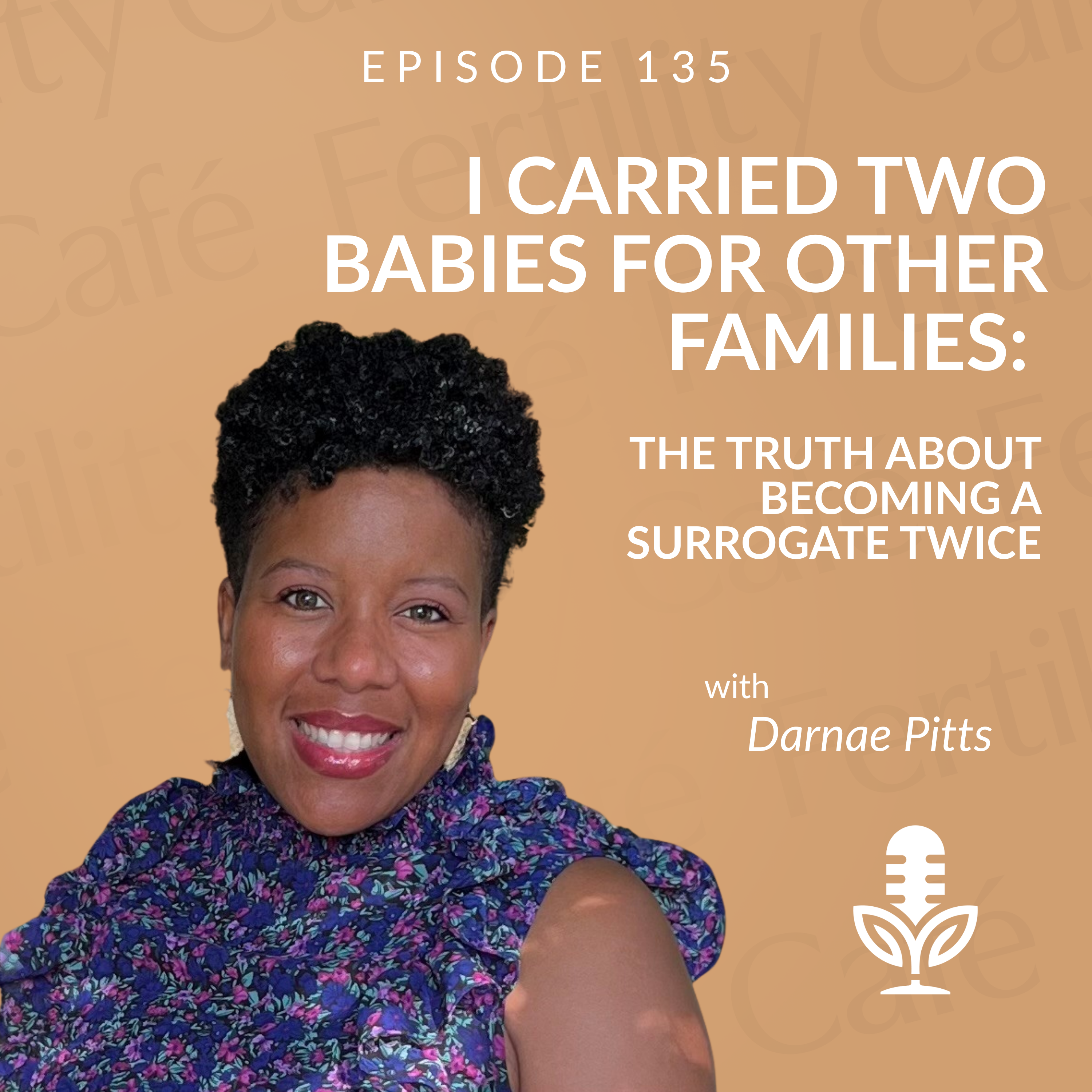
Today, I'm sitting down with Darna Pitts. Darnay is a devoted wife, a mom of two, and a two time gestational surrogate. She describes walking alongside other parents on their journey to meet their baby as one of the most rewarding experiences of her life. And she's seen firsthand just how life changing this journey can be. Well, Darnay, thank you for joining me on the show. I appreciate it.
[00:02:06] Speaker C: Thanks for having me.
[00:02:07] Speaker B: So I know you're a wife, a mom of two, and family is everything to you, but tell me a little bit more about you, like what first
[00:02:16] Speaker A: put you put surrogacy on your radar
[00:02:19] Speaker B: and then walk me through like both of your journeys because obviously we know you've done this twice. So how was your experiences?
[00:02:26] Speaker C: I love being pregnant. That was like number one reason why I scored this. I think parenthood is just such a gift and I wanted to give another family that kind of, you know, that feeling because it's huge. And so I started back in 2020, I was like, you know what, I'm just curious. Let me just kind of see what this is like. So I decided to explore the idea. But during that time, I was going through a divorce and didn't know how important mental health was for this process, you know? And so I googled some agencies, and the first one I chose, you know, was Family inceptions. And I was like, let me kind of explore this and see what information they have out here for me. Elle puts out a lot of information. Let's kind of see what this is about. Because I didn't have any idea about it. I applied. I got a call a few hours later, and she kind of asked me tell her about myself.
[00:03:15] Speaker B: And so.
[00:03:15] Speaker C: So I was like, I'm currently married, but I'm going through a divorce. I have two kids. And she was like, well, unfortunately, we can't take you at this time because we have to make sure your mental health is strong. And so I was like, oh, no. Oh, no.
So divorce finalized, reached back out again, got a phone call. She says, well, unfortunately, we can't accept you because, you know, you're a couple pounds overweight. And I was like, oh, man. And in my mind, I was like, oh, I thought I was living this healthy lifestyle. Me and my family hike, we eat healthy. And, you know, and I was comfortable in my skin. Just being comfortable is not appropriate all the time. You know, you kind of have to branch out. And it just wasn't enough to approve me. So I was like, okay. I asked her how much weight I had to lose, and at that time, it was like, 20 pounds. And I was like, wow, 20 pounds. I'm gonna be, like, skinny, not looking like myself, you know? And so anyways, it took a lot of motivation. Started working on my mental health. After going through a divorce, I started exercising, eating even better, and it took me about six to seven months. And I got down to my weight goal. Six to seven months, and I reached back out again. Then she's like, okay, perfect. You're approved. We can kind of move forward. These are what the next steps are going to look like. So I kind of had to understand that not right now meant a no completely. Family inceptions kind of helped me understand that. And so all the motivation and dedication, I was finally there at that point.
[00:04:35] Speaker B: In hindsight, though, do you now see why those things were important to have in place?
[00:04:41] Speaker C: Absolutely. You have to be healthy enough to be on the certain medications that you're going to, you know, be prescribed. You have to be mentally ready because you're going through a whole emotional journey. This is not your normal pregnancy. You're going to be on medications, hormone boosted medications. They're going to take you through different emotional stages that you would not have experienced through your pregnancy of your own.
[00:05:05] Speaker B: So how did you balance, though, everything? Your family, your life, and now you're carrying someone else's baby. And I know I. I jumped the gun. And you haven't talked about your first journeys yet, but while we're having this conversation, how did you balance it all?
[00:05:20] Speaker C: Honestly, I don't know. It took my husband and my journey manager to kind of like help me. My husband picking up extra responsibilities around the house, taking the kids to their extracurricular activities, cooking some days, and then my journey manager organizing all of my appointments for me so that I didn't have to stress.
It was a lot.
[00:05:42] Speaker B: So let's talk about, like, what your first journey was.
[00:05:44] Speaker C: It was very interesting. So my IPs were at every appointment, whether big or small. They lived about two and a half hours away at that time. I was working full time early in the morning, eight to five. Busy clinic schedule, life. And they were living two and a half hours away. They would show up early in the morning. Everything went smooth. The connection between us was amazing. I kind of felt like family.
And they invited me into their circle. I went to gender reveals, I had baby showers.
Every appointment went smooth. Started my stress test about 36 weeks every week until 38 weeks kind of hit a bump. Well, I could say not a bump in the road, but it was a shock to both of us. 38 weeks under my stress test, they said, oh, well, Darnay, your amniotic fluid's low. We're going to have baby like today. Oh, mind you, we weren't prepared. Their bags weren't ready, I wasn't ready. So it was a whole emotional meltdown in the exam room.
And they're like, darn it, it's going to be fine. But I kind of felt like I was letting them down in my mind. I'm like, okay, the baby, yes, is full term. Yes, he could come today. But none of us was, like, mentally ready. I get to the hospital and they put me under this 23 hour evaluation before they induced me. You can imagine all the emotional, like, feels that I was having the intended parents. We're like, okay, well, we're going back home and getting our bags ready, getting baby's bags ready. And I was like, oh my gosh, fast forward. The next morning, they started to induce me in my mind. I was like, okay, it's fine. Everything's gonna be fine. Baby is healthy. But he doesn't have any room to move around, but he's fine. I got to six centimeters, and he was, you know, kind of went under stress. And the doctor comes in and was like, darnay, now we have to do an emergency C section. I was like, okay.
[00:07:28] Speaker B: And this was your first.
[00:07:30] Speaker C: First C section, yes. Didn't know what to expect. Already had the epidural in my system, which makes me very sleepy regardless. But now they put more medication in me. We're getting ready to, you know, surgery. And I was like, man, this is a different feeling. I don't know what to expect. My husband prayed over me. He's like, donnie, it's gonna be fine.
Mind you, the C section was quick. I'm talking about from the time they rolled me back to the time the baby was out. It was like nine minutes. It was extremely fast. So I was scared. Mama was there. Usually they stand up protocol, they only allow one person in, right? But they did allow mom to come in, which was a relief because I did want her to be able to see the baby coming out. There was no complications. Baby didn't have to get to the nicu. He was perfectly fine. He was just, I guess, just ready, you know, to be here. Going into my second journey, I didn't have any complications, but my journey kind of looked different. They weren't able to attend every appointment. Every appointment. But they were on FaceTime, you know, and able to ask the doctor questions if they needed to check on me to make sure I was okay. I experienced more heartburn and reflux during this pregnancy, but it was, you know, it was fine. Each journey feels different. Each pregnancy feels different. I was older. My job situation's different. I was home every day. So, like, I was more in tune with my body. So all this was just different. Going into it. I decided to have a vbac. Well, to try a vbac. Didn't know whether or not I could do it. Doctor said because you've had two vaginal deliveries, you know, your first C section, you are perfect candidate to do a vbac. So, okay, let's try. It went all the way to 38 weeks, and baby girl decides that she was ready. So I think 38 weeks for me is just like, a good time, I guess. She was ready to come. I went into labor on my own. This is the first time that my water broke on its own. Even with my bio kids, my water has never broke. Things are moving, things are going. She's just like, she's ready. I went to the hospital about 4 cm dilated. Had an epidural because they wanted to have that in my system just in case I needed to go for a C section. But I didn't have to had the epidural.
Things starting to speed up. Contractions were, you know, getting stronger, and next thing you know, I was at 10 centimeters. She came out. She was beautiful. She was healthy.
[00:09:43] Speaker B: So what was it like seeing the baby with the intended parents for the first time?
[00:09:49] Speaker C: It was emotional, but I said to myself, this is my why. This is why I do what I do. This is the joy that I want to feel. It was so many emotions. Mama crying. And every time I looked at the baby, I was like, wow, I did this. My body did this again. It was so fulfilling.
[00:10:08] Speaker B: Was it that same experience and that same feeling the first time as well, even though obviously it was a C section. Completely different type of, you know, delivery.
[00:10:18] Speaker C: Of course, mama was in the first journey, Mama was covered up with everything, sterile, from the gown to the mask and everything. But, I mean, I could see her tears rolling down her face, and I was like, oh, my gosh, I did this. I was able to contribute this beautiful human being to this family, and now she's able to experience the joy that I get to feel. For second journey, Mama was there actually helping deliver baby. She was first hands on the baby. It was. She was right there. It was very vulnerable. Seeing all the emotional, you know, emotion in the room, it was awesome.
[00:10:52] Speaker B: So how did you feel after, like, delivery? Physically, emotionally? It's done. You got to see this amazing experience, you know, that you did that. I mean, how did you feel? Did you end up having any postpartum depression? Did you have any, like. Like, oh, my God, these people are not going to care about me anymore because now everything is done, and they don't need me anymore.
[00:11:17] Speaker C: No. I mean, obviously, I was tired with my first delivery. I was very tired because it was C section, so my recovery was draining. I went into, like, this recovery room for two hours. It took me a while to kind of, like, wake up and. And be alert enough to know what was going on. But I got to hold the baby and connect with the family, which was awesome. They. There wasn't a rush of taking the baby. Oh, the baby needs a bath. Oh, you know, I was physically drained, yes. But I was happy. I wasn't, like, I didn't feel any kind of depression. I wasn't sad because we connected to where I felt like family. So I was like, you know what? I'm gonna see this baby again. It's fine. Like, they're not, you know, they're not going to take him away from me forever. It was kind of like, he's my nephew. We combined on those terms. Second journey was different, but I knew they wanted me to have a relationship with them. It wasn't taking the baby away. It was more like, see you later.
You know, I connected with them and it was very intimate. Both settings were very intimate. But no postpartum depression or anxiety that I experienced.
[00:12:20] Speaker B: Nothing.
[00:12:21] Speaker C: Nothing.
[00:12:22] Speaker B: But was it something that you kind of prepared yourself ahead of time before you obviously delivered or whatever? And when you decided that you wanted to become a surrogate, was it something that just kind of naturally was or.
Because a lot of people think like, oh, my God, you're giving up a baby.
[00:12:39] Speaker C: You're.
[00:12:39] Speaker B: How are you going to feel afterwards? How are you going to have closure? What about when you go home and you don't have a baby and you
[00:12:46] Speaker A: just carry this child for nine months?
[00:12:48] Speaker C: I went into it knowing that I didn't want to have any more children of my own. I went into it with the mind frame of, I am carrying someone else's child. This is not my baby. I'm not bringing this baby home with me. I'm basically just like, how I explain it to the kids. I'm basically just an oven. I'm a healthy oven baking this baby. The baby is going to go home with their parents. I'm a big contributing factor. Yes. But it's not coming home. So all along, throughout the pregnancy, I told myself that. And as we gained that relationship over the course of nine months, it was very comfortable and easy to give them their baby back. It wasn't like, I'm giving up a baby. It's giving them their baby back. It's their embryo. It's giving them their baby back.
[00:13:29] Speaker B: When you did get home, now you're recovering and now, you know again, you don't have this baby or whatever.
Was there anything like, I wish I did this different or I wish something else of something else?
[00:13:45] Speaker C: No. So I breastfed while I pumped for my first baby for six months. So I got to see this baby every week for the first six months of his life.
[00:13:53] Speaker B: Oh, my gosh.
[00:13:54] Speaker C: Yeah. And so I immediately got back to motherhood of my own children. I didn't have any, like, regrets. I didn't miss having a baby, for sure. I definitely didn't miss having a baby. But your body with, like, hormone crashes, you kind of feel sometimes like, man, am I supposed to be doing something different? Is there Supposed to be an extra person here. You do kind of get those feelings. Like, I was pregnant, big belly for nine months, and now all of a sudden there's no baby here. There's nobody really to care for to that extent. Because my kids were independent, you know, they were a little older, so I didn't have to care for them to that. But it was lots of love and attention that I gave back to my kids that I kind of took away. Not necessarily took away. You feel kind of mom guilt. And so I gave all those back, those emotions back into my kids, poured back into the part that I was kind of missing. You kind of just go through all those fills. But I didn't to with breastfeeding. That was still for six months. That was still kind of a pull away because I'm like, oh, wait for 20 minutes. I have to, I have to sit down for 20 minutes, you know. But during my second journey, I did not breastfeed or breast pump. Yeah, I didn't pump. So those were kind of different. But I felt like I got my body back sooner. I kind of went back to reality. Like, there's not a baby here, so I really am diving back in. I don't have anything to remind me of, you know, the pregnancy because I'm not breast pumping.
[00:15:13] Speaker B: And I know obviously you did it first time and then, you know, clearly you did it a second time. At what point did you think of, like, doing it again? When did it cross your mind to like actually want to do it again?
[00:15:25] Speaker C: I know. So I really didn't feel complete. I felt like I had more to give six or seven months postpartum. I kind of decided to explore the idea again. Like, I talked to my husband and I kind of had to look at upcoming events because my kids life is very busy with extracurricular activities and high school activities, that kind of thing. And I was like, you know what, I really want to do this again. I felt like my body could give more. And the first thing I did was ask my husband. That's the first thing I did.
[00:15:54] Speaker B: I was like, did he have any hesitations or anything like that?
[00:15:57] Speaker C: He didn't, but he, he said, darnay, are you physically able? Do you think you're physically able to do this again? Are you mentally ready to do this again?
Because he was like my vent person. He would, he heard all of my complaints. My hip hurts, my back hurts, everything. He's like, darn it, are you able? And I was like, I think I am. Those are temporarily like aches and pains. That's in my mind.
I felt like it was just temporary for him. It probably felt like an eternity of me complaining or whatever, so. But he didn't have any hesitation. He just made sure I was ready.
[00:16:32] Speaker B: So what does your relationship look like now with both families?
[00:16:38] Speaker C: It's funny. I still talk to both of them with my first intended parents. First set of intended parents. I probably talk to them a few times a month. With my second IPs, I talk to her almost daily. She's constantly texting me, and she's like, darnay, how are you feeling? Are you okay? And she's, you know, sending me pictures. I feel like family with both of them. Even though both journeys were different in different ways, I still feel connected with them strongly. So, yeah, we have a phone conversation because they're. They're Both only about 2 1/2 hours away, so I can say, hey, let's plan the meetup for dinner. And they're perfectly okay with that. I fit into their schedule. I'm part of their life now because they're looking at this baby. And then I'm constantly a reminder for
[00:17:19] Speaker B: them, yeah, you know, obviously, I did it three times, and I can say every single one of my journeys in my relationship with the intended parents are completely different for every single one. You know, you just never know. So, obviously, yes, your family knows you're doing this, and you've done this for two different families. But out in the world, you know, like you said, you were working and then you switched jobs or whatever, but you're visibly pregnant, you're out in the world at the grocery store, your kids, school or whatever. What was that like? Like, how did people around you react when they found out that you were a surrogate?
[00:17:58] Speaker C: It was interesting. So I have a very small circle, but people that were close to me, they voiced that they were happy. Happy for me that I'm doing the great thing, that, oh, you know, I wish I could do that. I wish I could be a surrogate. But, you know, you can kind of tell people, like, confused about the situation, they don't know. People are very ignorant to this world of surrogacy and in infertility altogether. And it's never a quick conversation unless you talk to somebody every day, it's never a quick conversation. You kind of had to go into details, tell them what it's like, let them know that this isn't your baby, you know, the genetic pool of it, because they want to know. These are the first questions that I get. Well, how does it feel Given a baby, your genetics out in the world. I was like, it has nothing to do with my genetics. You know, it's all there, genetics. So it's always a conversation, educating constantly. And then those not close to you, you always get that look of judgment, especially to ones that thought they were there for you, but not really. You kind of get that look of judgment. People want to always know why they. So, yeah, you're always explaining more than what you thought you were explaining, like, in distant relationships.
[00:19:08] Speaker B: And did you get, like, any negative responses from anybody?
[00:19:13] Speaker C: Not necessarily negative responses. I had to educate my family. Darnay, why would you want to do that? Why are you putting your body through this again? Because they didn't know. And our culture is kind of frowned upon. You don't hear about it a lot. And I had to explain. I want to help somebody else. I feel like my body can give more. It's healthy enough to give more. Not everybody that have children are bad or they physically cannot have children because of medical reasons, not just because they don't want to get pregnant. And so, you know, in the celebrity world, they use surrogacy in a form of not using their body because they have stage presence and all that kind of stuff. But, no, it's not that. It's medical reasons to why they can't get pregnant. And so I want to be able to help those individuals.
[00:19:58] Speaker B: Obviously, you've carried four pregnancies, two of your own, two surrogacies, and that is a lot on your body.
So how did you know you were physically ready to do it? And then, you know, and how do you feel about your body now that it's all done?
[00:20:13] Speaker C: You definitely have to prepare. I knew from my first journey that I had to meet my weight goal. Regardless, if you were pregnant four times, five times, you have to still meet requirements. But I felt like my body was still healthy. I felt like I was still strong. I felt like I was still mentally capable of doing it again. I felt like my family was more at an understanding. My first pregnancy, you know, I was 37. Yeah, it's advanced maternal age, but I felt like I was in shape enough to do it, you know, to do it again. I was restored. I felt like I was replenished, and I was getting my body back on cycle. It was kind of doing its routine things.
My second journey, I was going into 38 years old at that point. I think I can do this. I'm pretty sure I feel energized. You know, I didn't feel stretched, and that Was what kind of what my husband was, you know, referring to. Are you physically ready to do this again? I look in the mirror and I see my stretch marks and I'm like, man, can I really do this again? But I look at my stretch marks is like, I give life. That's. This is what I do. This is what my body can do. And I'm blessed to be able to do this for somebody who can't and who can experience these stretch marks. And so, yeah, so it was time to, like, work on me and give back and know that I can do it again.
[00:21:29] Speaker B: Did you learn anything from, like, your first journey to your second journey that you like, I need to change that or I wish I knew that first before I went into it or, you know, whatever was. Did you have any learned experiences from journey one to journey two?
[00:21:46] Speaker C: Yes. That is very intense.
It's very intense. Medical screening is very, very intense. I wish somebody would have told me. Everything isn't black and white. There's hiccups. Everybody's journey doesn't look the same. Shots to the oral hormones that you have to take. Your body goes through so much before you even go to transfer. Like before you had this little baby inside of you, it goes through so much. You're the schedule so strict and you have to be flexible. Going into my second journey, it was not necessarily a breeze because you kind of forget all those tedious steps. I was quickly reminded that it is an intense process. I was quickly reminded of that. Yes.
[00:22:29] Speaker B: Yeah. And I don't think that people really appreciate the process that it takes just to get to transfer.
[00:22:36] Speaker C: Right, right, right.
[00:22:38] Speaker B: It's like, there's a lot that happens. There's a lot that happens in the background. There's a lot that happens that you have to stay on top of. Like, these aren't things that you can just like, eh, I don't feel like doing that right now, so I'm just not going to.
[00:22:52] Speaker C: Right. You have to be committed. You have to be all in.
[00:22:54] Speaker B: Oh, yeah. Let's talk about boundaries, because obviously it is their child, but ultimately it's your body and you have full autonomy over your body. Was there any time, any moments where you had to kind of like, speak up for yourself or set a line that just felt uncomfortable, but you knew you had to do it just to make sure that you had your own peace of mind?
[00:23:17] Speaker C: Yes. During appointments, like I said, they. My first set of intended parents, they were there for every appointment. So I kind of had to like, set boundaries and make it clear on where they stood in the room, because it's very vulnerable in there. You're very exposed. Also entering into, like, your personal space at this point, they're almost knowing everything about you. So you have to be very transparent and expressing that, because, like I said, you're carrying their baby, but this is your privacy to your pregnancy. And I had to make it clear, like, here, you stand over here. This is, you know, I'm more comfortable with you standing here. My husband can stand close to me, but you can stand over here type of thing.
So it's just setting those clear boundaries. It wasn't awkward, but we set those in the beginning, and they respected it. And same as, you know, delivery.
[00:24:03] Speaker B: I was going to say, what about delivery? Especially when, you know, intended mom is catching the baby.
[00:24:09] Speaker C: Yeah. So in the beginning, my nurses were very open as well, and they made it clear. They made it easy for me because I said, I made them, you know, aware up front that I want them to stand kind of behind me because I'm exposed. And having another man in the room, it can be very uncomfortable.
So my nurse was great. She was like, hey, you know, Darnay wants you to kind of stand up here until the baby comes and that kind of thing. And they asked. The nurse that delivered asked me. She said, darnay, is it okay if mom comes and catches the baby? That kind of thing. And I was like, you know what? Absolutely, mom can. But dad stay. He was very respectful, and he stayed at the top of my head, you know, with my husband, and let mom experience all of that. But setting those boundaries in the beginning is very important because you are under a lot of stress, but you don't want them to feel like not a part of the experience.
[00:25:01] Speaker B: Definitely. Obviously, there's a lot of women out there who right now want to be surrogates.
But can or should everybody be a surrogate?
[00:25:11] Speaker C: Absolutely not. You want to say yes, but no. Not everybody has that mindset. It's a certain age range that you have to fall in between, you know, ages 24 to 39 kind of thing. And I had to know that. I was like, man, I'm getting to the end of my, you know, that age span. You know, I was like, if I'm going to pursue this, I need to pursue it now, because I know it takes time. You know, you have to have at least one successful pregnancy without any complications.
I was reading that you couldn't have any, like, miscarriages or abortions as your last pregnancy. You have to carry out successful pregnancies. You had to be healthy. Trust me, that hit me on top of the head when they said you have to be healthy under a certain bmi, man. They told me that straight out the gate.
So your BMI has to be under 30.
Can't be a smoker. Obviously people think, you know, I'll smoke, you know, here and there. But I'm like going into it, you have to be healthy for your own pregnancies. Carry that same mindset when you're carrying somebody else's child.
You have to, you know, care about your body in the same way.
You have to be, you know, in a stable relationship and absolutely a strong support system. If you don't have a good backbone then to carry you through this, then you can't be a surrogate.
[00:26:25] Speaker A: So what do you think makes a
[00:26:27] Speaker C: good surrogate mentally strong, Being mentally stable? It's all about the mental aspect of it, you know, that's the biggest quality I would think, carrying into it having your support system, being open and honest with yourself and with the agency that you of your choice and with your IPs, you have to have that.
[00:26:47] Speaker B: Yeah, 100%.
So what about somebody who's already been a surrogate before and she's thinking of doing it again? What's the first thing you'd say to her?
[00:26:56] Speaker C: I would say go into it with an open mind, understanding that every journey is different. Regardless if you had an awesome experience, your first time personalities are different, your preferences may be different. I wanted friendly relationships, open communication, but that still looks different. Some people are more touchy feely than others. They want to hug, they want to rub on your belly. Some people want to be friendly but at a distance. So I would say just go into it with an open mind and again be ready to commit and go all in. However they take it, you just be there for them.
[00:27:32] Speaker A: What do you wish somebody had told
[00:27:33] Speaker C: you before you started that the medical screening was crazy intense. The process is long, that the compensation that you're looking for isn't quick. You have to go through phases before we even get to the money part of it. So I just think that all the things in the beginning I would have known prior to going into it that like the injections, because they are very painful, that you would have helped getting those even. You know, I have a medical background, I know how to give injections, but I absolutely did not give them myself.
And I would not recommend anybody giving themselves.
[00:28:07] Speaker B: And I did. Girl who. Yes, I did. Yes I did. All three of my journeys. I had to give them to myself.
Yeah, it was wild. It was definitely wild. Last question.
So you've had two journeys, two deliveries, two families that obviously exist because of you. You said that, you know, walking alongside the parents on their journey has been one of the most rewarding experiences of your life.
[00:28:32] Speaker A: But tell me how surrogacy has changed you, Darnay.
[00:28:37] Speaker C: I feel like it's changed my life for the better. I feel like now I have a purpose. I felt like surrogacy was my calling, and I answered it with these two journeys. Very emotional. But I feel like now I have stories to tell, now I have feedback to give, and hopefully my stories get shared from around the world. You know, for people with infertility issues, look for a surrogate like myself to be able to create their family. And so I just feel fulfilled doing that, and I open doors for other families.
[00:29:08] Speaker B: And what about your own family, your children and your husband?
[00:29:12] Speaker C: Definitely a big goal and accomplishment. They look at me like a stronger woman, especially my husband. He. He's like, I don't know how you did it, but she's a boss. That's what he always says. And my kids are like, wow. I have conversations around my daughter, who is now 16, and she's like, I really wish I could do this. I really wish that I could even, you know, get pregnant and enjoy pregnancy like you did and enjoy motherhood like you did. She's kind of starting to look up to me in that aspect. She's starting to ask me more personal questions about reproduction and that kind of thing, and so I feel like I can just give that back to her and share that with her in a vulnerable state.
[00:29:47] Speaker B: That's awesome. That is awesome. Darnay, thank you so much for being here and for being so real with us today. I really appreciate it.
[00:29:54] Speaker C: Thank you for having me.
[00:29:56] Speaker A: Thanks so much for listening to Fertility Cafe. If you've enjoyed this episode, be sure to subscribe so you never miss an interview. Leave us a review and connect with us on socials. We're fertilitycafe.
You can also watch the full video version of today's conversation over on our YouTube channel. Until next time, remember, love has no limits. Neither should parenthood.