[00:00:00] Speaker A: For decades, Michigan has been known for having some of the most restrictive surrogacy laws in the nation. Families facing infertility or those unable to carry pregnancies themselves have been forced to cross state lines, navigate legal gray areas, or abandon their dreams of parenthood altogether. But a seismic shift is underway in the Great Lakes State. After years of advocacy and personal sacrifice from families directly impacted by these outdated laws, many Michigan is finally turning the page on its restrictive past. Today, we'll hear from the woman who transformed her personal heartbreak into a powerful movement that's changing lives across Michigan. Her story shows how determination, strategic advocacy, and refusing to take no for an answer can reshape the legal landscape for thousands of families.
Welcome to the Fertility Cafe, where we explore the beautiful complexity of modern family building.
I'm your host, Eloise Dr.
And this is a space for honest conversations about surrogacy, egg donation, and the journey to parenthood. With expert insights and real stories, we're here to guide you through the medical, legal, and emotional aspects of third party family building.
We believe that love has no limits and neither should parenthood.
Welcome to Fertility Cafe. I'm your host, Eloise Drain. Today's episode takes us inside the remarkable transformation of Michigan's fertility and surrogacy laws. We'll explore how one woman's journey through infertility and surrogacy challenges led to the creation of the Michigan Fertility alliance and ultimately to the passage of the Michigan Family Protection act, which is now officially in effect.
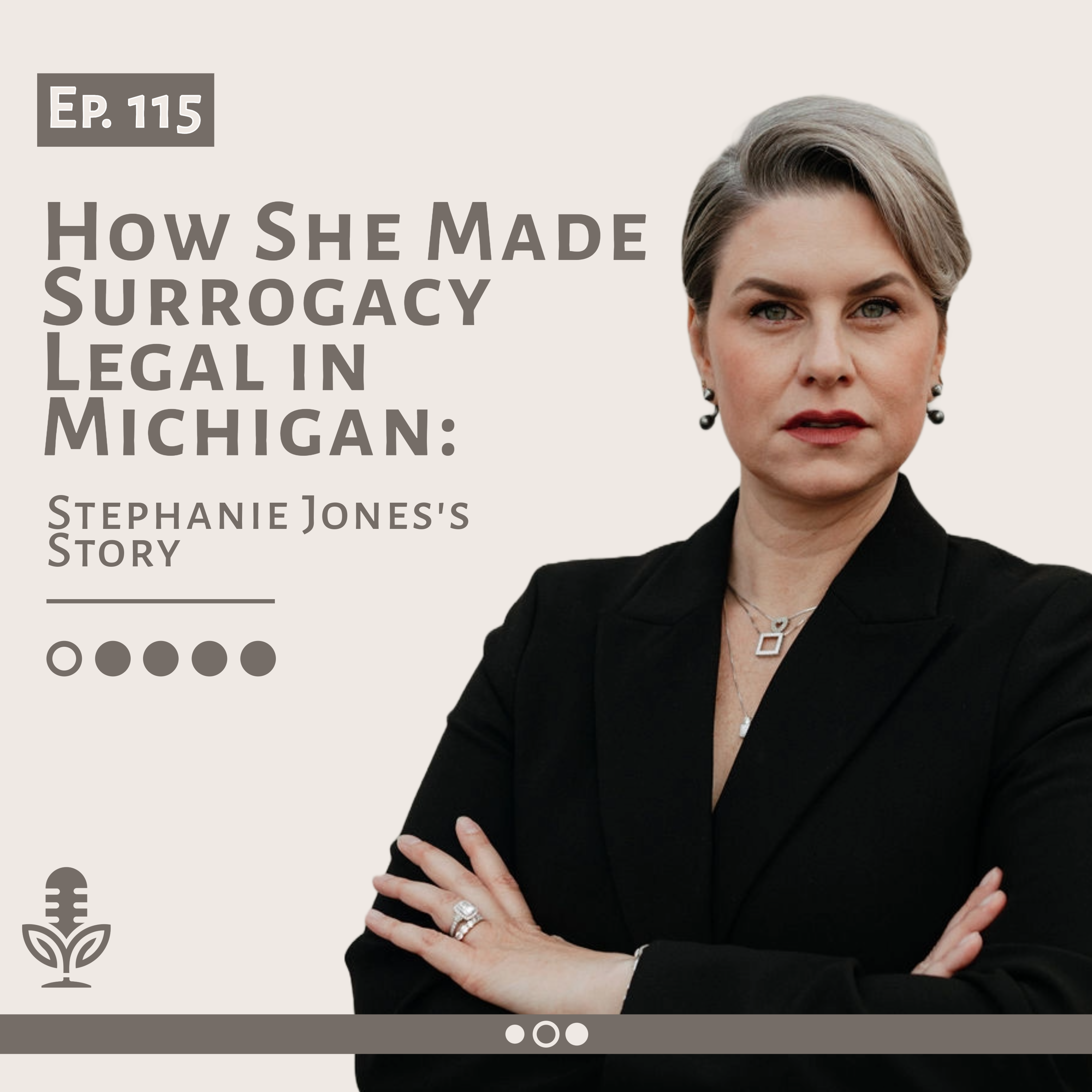
Before we dive into everything, I want you to picture this for a second. You've just survived a life threatening pregnancy, you're ready to grow your family, and then you find out it's illegal to do so in your own state. That's what today's guest's reality was. But instead of walking away, she rolled up her sleeves and helped change the law for every future family in Michigan. I'm thrilled to welcome Stephanie Jones, founder of the Michigan Fertility alliance and a driving force behind Michigan's historic fertility law reforms. After facing life threatening pregnancy complications and secondary infertility, Stephanie discovered that Michigan's laws banned surrogacy contracts, her only option to grow her family. Rather than accepting defeat, she channeled her business expertise as a company VP and her personal determination into founding the Michigan Fertility Alliance. Under her leadership, MFA transformed pro family advocacy in the state, culminating in the passage of the Michigan Family Protection Act. Stephanie, welcome to the show. I'm so glad you're here.
[00:03:01] Speaker B: So excited to be here with you today and talking with somebody that Just uplifts all the work that advocates like myself do across this country. So thank you.
[00:03:09] Speaker A: Well, thank you. I appreciate that. So before we dive into policy, let's get to know you. You're a business executive, a founder, a mom, an award winning advocate. Can you walk us through your professional background and how it collided with your personal fertility journey?
[00:03:27] Speaker B: A bit of a backstory. So obviously I have two children, one who I was able to carry without any incident, had no issues. And then I experienced secondary infertility.
And a lot of the skills that I developed as a business owner and as a leader, I put into practice. When I founded the Michigan Fertility alliance with really, the goal was, I would say it was founded by accident and because when I became unable to carry a pregnancy and found out that surrogacy was going to be our only option to have another child, and then to learn about Michigan's surrogacy ban while in a hospital recovery bed recovering from the surgery that had ended my ability to carry a pregnancy, at that moment, kind of, I went into doer mode. Everyone says I'm a doer. So it was like, what skills can I draw upon from my professional experience and my educational background as an engineer and to put a project management. I mean, I don't mean to make it simplify that much, but really, this giant project that started in 2019, and here we are in 2025 with a law that just took effect on April 2nd.
So that was what I was able to leverage in my professional life to really benefit my advocacy life and get this law changed and make meaningful impact for so many families in Michigan that start and grow through sister reproduction and also across the country. Right. Because people look to Michigan as kind of an example of how to do this in a time when it's challenging to get policy passed and then use that as a springboard to start State Strong, which is a national coalition of state level advocacy groups.
[00:05:07] Speaker A: Looking back, do you think your turning point was when you were on that bed recovering, especially given this is such a private issue? You know, so many people, it's like they don't even share with anybody that they're dealing with infertility, let alone, okay, now I have to work with a surrogate. And you go from that and having someone tell you, like, this is your only option, it being a private issue, to becoming so public and saying, okay, I have to do something about it. I mean, was that a thought for you at that time or was it, let me just figure it out for myself and see if I Can, you know, help myself?
[00:05:51] Speaker B: Yeah, absolutely. I mean, you kind of how you ended that question was exactly what actually happened. I know a lot of people think it's some like, sexy story that it happened in this exact order, but there was a long time, you know, a good period where I really kind of shut myself off to the world and I had to as self preservation. I mean, I went through a near death experience in 2016 when I had the corneal ectopic pregnancy and a uterine rupture. And that was. I was in ICU for a week. And then to have a reoccurrence in 2018, that was the actual end of, so a reoccurrence of an already medically rare type of complication. And then to be medically unexplainable, how it happened again. When we tried to get pregnant again, I spent a lot of time physically recovering, mentally recovering. There were, you know, the exhaustion of just the. And the mental fatigue of just what that recovery looks like. And then the emotional component with my, my husband and my family talking about that was going to look like. Then when we start to really dive into surrogacy, we learned about our horrific surrogacy laws in Michigan that basically make it impossible to move forward with a legally protected surrogacy arrangement in our state. Obviously that isn't anymore, but, you know, what are our options? Then you start looking at the cost of surrogacy and then you get even more crippled because how are you going to move forward with something? And it was much time spent in, I would say, like a crippled phase. And then I just finally realized that I was going to have to pull myself up by my bootstraps and I was going to have to put one foot in front of the other to not only advocate, but to do the work that was going to be required to ultimately have our daughter, who our daughter was brought into this world by an amazing woman, a gestational carrier in Kentucky.
So it was kind of two part. And then once I started getting, I feel like my sea legs with the surrogacy process, coming to terms with what that process is like, then I started to see like an opening for taking this anger, for lack of a better term, that I was experiencing that I was forced to do all of this in an already very complicated process and make it even more complicated because our state laws and then also understand that there were many people that didn't even. That couldn't do what we were doing because they don't have the resources to leave the state.
So then I took that anger and kind of put it into action and started organically growing Michigan Fertility Alliance.
[00:08:20] Speaker A: But how did you start? Like, I mean, it's one thing to say I've been in politics. I've, you know, have a background in it. I've done, you know, all kinds of stuff to saying wasn't really something that I was into, but I had this drive in me that I'm going to figure it out.
[00:08:42] Speaker B: Well, it all started with a Google search, I'll tell you that. I mean, I hate to make it so simplistic, but it was in the recovery room after the second surgery in 2018, when I Googled and learned about Michigan's ban on contractual and compensated surrogacy, which is legal surrogacy with legal protections. I learned about that, and that was really how it actually started. And then from there, I reached out to an organization. I said, I have this unique skill set. I really want to use it to change Michigan law. And that national organization got back to me and said, you know, that's amazing, but there's really no group in Michigan doing that. And I thought to myself, huh, well, I guess that's going to be what is what I start. So I always say, was started by accident, to be completely honest. Right. You see a problem and you fix it. Which many doers can appreciate that, like, you're just going to fix it. I never said out to form Michigan Fertility Alliance. It was just to right a wrong, Right this. We needed to fix this law because it was antiquated.
Surrogacy in Michigan was misrepresented, underrepresented. It was demoralizing. I mean, I could go on forever. So that is how Michigan Fertility alliance actually started, was that moment when I was told, well, there's no one else doing the work. So it meant we were going to need to do the work. And then at that point, really started. I always say, you know, it's like kind of like making a nest. That's the best example I can say is, you know, you watch birds, it's the spring, you know, building their nests, and they're gathering sticks and pieces from this, and. And they're being resourceful. And that's what ultimately I was doing. Meeting the right people, having the right conversations, engaging with other advocates, collecting stories. We catalog hundreds of stories of families across the state who needed assisted reproduction and had roadblocks and. And talking to people who would be willing to share their story in a more public setting. So at that moment, it's Kind of interesting. I had been very private about my story. I really hadn't talked about it because it was extremely traumatic and I was not ready to talk about it. The PTSD just really wasn't. I got to doing things instead of actually dealing with my trauma. So it wasn't until, you know, a couple years in that I was even comfortable sharing my story because we had to process a lot of the trauma that came along with it. That was. Cause my family was in the room when I nearly died. My husband, you know, all these things. I had my son at the. My son was 3 at the time.
So then I became. It was more out of necessity. And this is kind of the part where I somewhat struggle with. Because I feel like we're in a time now where we have no other option but to share our story, to humanize an issue that is very real. I didn't have an option if I wasn't willing to share my story in a compelling way, to tug on people's heartstrings, to understand that this is a reality many people are facing.
How was I going to affect change? And how was I going to lead other people to give them the confidence to share their story while keeping some things precious? Right. I always say share your story in a way while you still protect those things that are precious to you and your family and whatever seems what you want to keep private.
So it's hard to be a leader and a servant leader when you aren't willing to. So I came. I came to terms with that, and I was able to. After I took Planned Parenthood storytelling class, I took many other storyteller classes. And I really learned how to tell my story in a way that was impactful to the. To the listener, but meaningful to me as well.
[00:12:15] Speaker A: So let's step back for a second because I think there might be listeners who aren't familiar with Michigan's fertility law history.
Can you explain what the landscape was before your advocacy work began? I mean, obviously, I know there was a ban, but why was there a ban?
[00:12:33] Speaker B: So the ban took effect in 1988. Michigan has an extremely significant role in surrogacy in our country, and many people do not know this. And it was the work of our communications director, Janan Brownell, with Michigan Fertility Alliance. She's also a investigative journalist, and she uncovered so many facts that found that people were just shocked.
So in 1986, actually, the first child born through gestational surrogacy was born in Michigan. People do not realize that her name is Jill, and Jill now lives in New York and we actually on our website, if you want to. It's the first interview we've ever, ever that she's ever done. We interviewed her. So there's that. So then also the attorney for the Baby M case, Noel Keene, was a Michigan attorney. So we have to understand a couple of these. They were happening at the same time, but unrelated.
So we're going to now go to the Baby M case, which that is a. That was a genetic surrogacy. That was in the 80s. Obviously, anybody listening to this who's familiar with surrogacy will tell you surrogacy is. We are. It's light years different now than it was then.
So ultimately what happened is the law was written to put Nolke out of business.
That was not uncommon back then, how statutes were done. Our state government didn't want the babym case technically happening anymore in Michigan. So it was kind of. They took a very dystopian approach to this law, not realizing the extreme consequences that were going to come from it because it was going to be left frozen in time for almost 40 years. And that's in essence what happened. They passed the law. It was actually a Democratic governor at the time passed the law, and it just stayed there. It stayed frozen in time. So we went from the first, literally the first in our country to have a just national surrogacy then to being the first state in our country to ban surrogacy.
So it was just very interesting to now the last state in our country to lift a criminal and civil ban on surrogacy. So it's been a wild journey. And a lot of it boils down to a simple fact of awareness. People did not know the why behind the law. A lot of people didn't even know the law existed. We had lawmakers tell us when we would meet with them. That can't be right. There's no way Michigan has a law like that. And that was ultimately, that's what happens right when. So especially when laws are written about medical practices and things that involve science and all of that, it really.
When left frozen in time, it's extremely harmful.
If you're not advocating and making your voice heard and organizing and the fact
[00:15:21] Speaker A: that you are, you know, supposed to be lawmakers and you don't know that this law even exists is very telling, doesn't it? Isn't it?
[00:15:31] Speaker B: They're busy. I will say I've got to appreciate the politicking side of politics. And they're busy. They have A lot on their plate. I mean, they are trying to represent the people that elected them in a way that, that is wholesome. And they, along with aligning with their own party's agenda and so on and so forth. It's hard. I mean, they have hundreds and hundreds of bills and laws that they're reviewing and expected to vote on and so on and so forth. So it really, unless you find a very passionate lawmaker like we were able to find in our representative, Samantha Steckloff, who's going to need surrogacy to grow, start and grow her family, she's a cancer survivor. It was really that personal connection with her that was kind of the, you know, ignition to our efforts. If it weren't for her, we wouldn't be having probably having this conversation right now.
[00:16:23] Speaker A: But how do you find someone like that, though?
[00:16:26] Speaker B: That's a great question.
You know, advocacy day, we had Michigan Fertility alliance hosted our first ever advocacy. Michigan's first ever advocacy day around.
No, this was our independent advocacy. This was independent to us in our state.
And it was around family building and infertility. Right. Because those real two things go together. You can't talk about them independently.
So frequently our community, we talk about one without including the other. So our advocacy day was about people who need assisted reproduction to grow their families, and that included surrogacy. And just, I just coincidentally, I was on the call with Sam Steckloff or Rep. Steckloff. So we had a Michigan Fertility alliance leadership member on every single call with every single lawmaker in addition to their constituents. And it just coincidence, I was on the call with her and she was just said to me, like, this is so important to me. Oh, my gosh, I'm so glad we connected. And that was, you know, the rest is history. That was in 2020 when we connected and we got to work immediately and
[00:17:31] Speaker A: then doing all of that through the pandemic.
[00:17:35] Speaker B: All of that through the pandemic. Yes. That's so true.
It was, I mean, my daughter was born in the pandemic. My daughter was born, you know, early on in the pandemic when we were in still, like I said, the scary phase where people, you know, you weren't leaving your house and all of that. And then also really getting to work on this law, you know, it really is what got me through, I think a lot of the stressful moments of the pandemic and having another or having a child and, you know, being born in another state with another amazing woman carrying your child. I mean, so many things that were. I always say the best analogy was I felt like my mental state was a board suspended on two ends with cinder blocks with a boulder in the middle. And it was just like a feather that was going to trickle down and, you know, blow it all to pieces, because that's how fragile the mentally I was. It's very stressful.
[00:18:23] Speaker A: Yeah.
[00:18:24] Speaker B: But the law kept me busy and working on the law, and again, kind of like I said early on, building that nest and gathering people and talking to anyone who would listen and anybody who was willing to educate me. I'm an engineer, I'm a entrepreneur, I'm a business person. I had zero knowledge on how you legislate, how you draft laws, nothing. So I guess if anybody hears this, you can affect change, and you don't have to know how, but you have to be willing to learn. And that's. I mean, we learned and we learned quickly.
[00:18:56] Speaker A: So you talked about you having to have your daughter in a different state.
Can you walk us through what that experience was like, especially, again, during a pandemic? I mean, how did you manage with it being a pandemic? She's going to have to be born in a different state. I'm assuming, obviously, because of the restrictions in the state of Michigan, that there may have been different specific language that your attorneys may have had to include in the language or in the contract. Was there anything like that?
[00:19:29] Speaker B: Or.
[00:19:30] Speaker A: Or was it just. She was born in Kentucky, so we just used Kentucky law and it was fine.
[00:19:35] Speaker B: Yeah. Michigan law had nothing to do with our journey. We obviously made a decision to leave our state for the entirety of the process. So we actually used ORM in Portland, Oregon, and we had a wonderful experience with them. And because of Michigan law and the way it was written, you couldn't. You couldn't legally do anything in the state if you were involved in a contractual compensated surrogacy.
So even basic testing and stuff had to be done out of state. So I ended up basic. I moved to Portland for about a month and a half. Just. We rented an Airbnb and I picked up and just went out there. And then my husband and my son, they'd come out there and my parents, just to visit while we created our embryos. And luckily, that was obviously before everything shut down for the pandemic. I am so grateful. I can't even tell you how many things I'm grateful. I always say that my guardian angel, the one that saved me, you know, in December of 2016, I mean, they were with me through this process.
So we create our embryos. We found an amazing agency to do the, you know, the real professional aspect of surrogacy. It's extremely, extremely for anybody listening to this that's never been through the process and anybody who has been through it will relate. It is a full on full body, full mental, all in 10 times harder than even another full time job type of journey. And this is a year plus long.
And for those people that even that attempt to do it independently, like more power to you because there is so much that you don't know. It's like the saying, you don't know what you don't know. I mean, that is why an agency or a matching service is so critical. They have all of the experience to kind of understand how to navigate the process, how to do it in a way where all parties are protected. So we found an amazing, amazing agency. Then we were eventually matched with our carrier, our canary. Our carrier was actually based in Kentucky. So here we were from Michigan, out in Portland, creating our embryos to be matched with a carrier in Kentucky. So our carrier went and her spouse went back and forth to port or to, or a couple times through the, you know, the, for the mental health screening, the medical screening, so on and so forth. Then going back for the transfer and then back for. At a home clinic for monitoring before being moved over to an ob gyn.
So at about to get to kind of the end of the story. At a couple weeks before our daughter was supposed to be born and she was going to be born at the only hospital in Kentucky that had surrogacy protocol, meaning they knew how to handle a surrogacy. They understood who the parents were, they understood who the carrier, what they understood the process, which again, it's an extremely complicated process when it comes to. Now we're talking about the parentage of a child who gets to make those critical decisions. So two or about two weeks before we were gonna be going to our carrier was gonna have our daughter. Covid was in like had taken over everybody's lives. At this point, we're in full swing of COVID where, I mean you can't. The restrictions are everywhere. Kentucky had a 14 day quarantine before you could come into the state, you had to quarantine for 14 days. So very long story short, our carrier OB GYN's secondary admitting privileges were revoked from this hospital.
So.
[00:22:53] Speaker A: Jesus.
[00:22:55] Speaker B: So we had to work with our attorney to work with the risk management team at the hospital that our. We were going to be delivering at to Write surrogacy protocol. Yeah. So because obviously we. And also because we wanted to be in the room to see our daughter born. That was a whole other component I haven't even touched on. Not even just the legality of who gets the bracelets with the baby's name on it and making sure that they understand that the carrier isn't the parent. I mean all of these things.
Then it got to, well, we wanna see our daughter be born. Well, at that point, most hospital had a one person rule. It's the person delivering and one person. I mean that was across the board.
Well, I was certainly not gonna ask our carrier to not have her support person in the room because I do not think that that is, that wasn't even on the table. I was not gonna ask that. And if that came down to it, that was just a sacrifice that we were gonna have to make and just trust our carrier as we had done for a year.
[00:23:53] Speaker A: Right.
[00:23:54] Speaker B: We're able to negotiate with the hospital that if we sign this crazy affidavit that we wouldn't leave our house and all this stuff, we could actually be in the room to see our daughter be delivered. And that was one of the most life changing moments of my life, which made me even more of an advocate for surrogacy is to deliver your child from another woman. Literally deliver.
That is power. Like, that is empowerment. That is, it's beyond what love and compassion looks like. Let me put it that way. And 24 hours they wanted us out of the hospital, like 24 hours they were, they didn't want people staying there and all that. So here we are driving home from Michigan with a 24 hour old baby. It was wild. So this, the experience, and it kind of was a bookend to why Michigan law needs to change.
[00:24:45] Speaker A: Yeah.
[00:24:46] Speaker B: Had we been able to have our daughter in our state, that experience would have looked much different.
[00:24:51] Speaker A: Yeah.
[00:24:52] Speaker B: I mean driving home seven plus hours with a 24 hour old baby is something I wouldn't wish on my worst enemy. You're already exhausted. We're just trying to get home. I'm, you know, at one point just trying to console her and I thought, this is wrong.
Why are we forced to do this? This is terrible.
So obviously we made it back with her and that gave me even more. I always say, wood for my fire. Like more wood for my fire. That this is to change. Like we need to allow people the option to be. Have legal protections in place, a proper legal regime to make sure that all parties are protected. The carrier, the parents, and the child a B. We need to be compassionate to the understanding that a lot of the journey in surrogacy is already being taken away. Right. You don't have that normal pregnancy experience. And I know this because I had it with my son. And we make a choice to do that, but it shouldn't be because of an outdated law.
[00:25:53] Speaker A: So let's go back to the Michigan alliance that you formed. And early on, would you say that there was challenges in getting people to pay attention to this issue? Because, you know, to your point, the politicians. Everybody's busy, everybody is focused on what they need to be focusing on. I mean, just regular, everyday people. If this is not part of their life and this is not part of their story or they don't know anybody, that this is part of their story, it's irrelevant. It doesn't matter.
So how do you get people to pay attention to an issue that probably a majority of people. It won't affect them. And then how do you begin building a coalition of, you know, supporters, even though, yes, you know, there are people who have gone through this. But is that even enough?
[00:26:45] Speaker B: You bring up a really interesting topic, I think that people in our space of advocating for families that start and grow through assisted reproduction are dealing with all the time. Right. It kind of even, you know, I guess I'm going to even parse it back to this idea that when the attack on abortion was happening, everyone was like, oh, that's abortion. Well, an abortion saved my life. So I do. I'm very. Obviously, I have shared my story, and I am very open about that. And I don't mince words when I say that my doctor was able to make an unencumbered decision in a moment, literally minutes, between my life and death to provide me the care that I needed. So we're going to parse it back to the argument of, well, that isn't going to affect us in the space of infertility. Well, here we are, and it's becoming a real issue because it took the lid off the ability for embryos and fertilized eggs to get rights. Right. Personhood rights. So that should prove that we're all in this together.
And obviously, we didn't have a crystal ball to know that that was gonna be the reality. But what we did early on, to answer your question directly, is we really just leverage people's personal stories and we talked about their struggles because a human can connect to another human and the struggle to build a family regardless of the circumstances.
And that was what we really, really Emphasized I didn't choose to put be in this situation. I didn't. So to have a law discriminate against me was something that people really were affected by. They, they agreed to that. Like they, they definitely understood the call to action that was, this could happen to any of us in the space of infertility and those that need assist reproduction or IVF or anything to be to grow our family. So initially our focus was very surrogacy based. Obviously we were talking about only families that were needing surrogacy. And then we regrew our tent. I say like our tent grew as our process went on to include all families that were born or start or growth to assist reproduction. So parentage laws and all aspects. But the most important aspect was on the surrogacy component was to explain that many people wind up in the space of needing surrogacy without knowing it. So if we are going to outlaw what is a very real, effective and safe treatment for many forms of infertility, nobody has a crystal ball to know where their life's going to take them. So we have got to leave this option on the table. And we have to do it in a way that is safe for everybody involved. And in the current state, in Michigan right now, because of the loophole in the 1988 law that allowed for people to move forward with surrogacy with no compensation and zero legal protections that should concern people, that should keep people awake at night. And that's what we actually really played upon, was the vulnerabilities that the 1988 loophole left people in. And when your back's against the wall, you will do things that you never thought you would have done. So in the state of Michigan, the carrier was viewed as the parent all the way through birth and typically took two years of an adoption to have the intended parent's name actually be on the birth certificate. So this poor child is just vulnerable through the entire process. If something catastrophic happened in the state of Michigan, this is what I tell. I don't mean to scare them. I meant to educate them. If something were to have happened to the intended parents, that was a catastrophe and they unfortunately, you know, lost their lives. The state, the, the gestational carrier is the parent of the child.
So your next of kin, your parent, they don't actually have rights to that child.
So I, I would say it as simplistic as this. We have contracts for literally everything in our life, from gym memberships to cell phones to everything. Think about that. But yet a contract in the State of Michigan to define what the surrogacy arrangement was, was not legally recognized.
So. So like, when you say it like that, people just think to myself, think to themselves, like, well, that's not right. And that's how we got a lot of momentum. Was just kind of. It was hard to not go from an affirmative place, but to kind of shine the light on the vulnerabilities. People did not like that at all.
[00:30:53] Speaker A: Oh, I'm sure, I'm sure. How did you manage though, all the responsibilities that you had? You're now, you know, a new mom again. You already have another child, obviously you're a businesswoman. How did you manage all of your responsibilities and be able to create this advocacy that has made this change for the entire state and potentially across the country?
[00:31:21] Speaker B: It was with a lot of sacrifice and a lot of prioritization. I tell people that it was definitely one of the most challenging times of my life because I had a lot of mom guilt, I had a lot of friendship guilt, I had a lot of wife guilt. Just across the board because I. Anybody who's worked on policy or anything along those lines, they can appreciate it happens. It goes from a waiting game to we are full on hair on fire rush mode. So a lot of things just had to be put on the back burner during that time. And it wasn't glamorous. And I definitely even my self care and things. And I wish I look back and I think, man, I really, really did not prioritize even my. Myself and my health during that time and you know, like the 15 pounds of cortisol weight I finally lost and all that. I mean, I see pictures of myself and I don't even recognize myself because of just. You could just tell how stressed I was. So I don't have a great answer. It was really just a project tackling the next task at hand while also keeping all the other plates spinning in your life.
The one critical thing is, I will say, is having a partner in life that supports your work and doesn't hold you in contempt. And that was something that, you know, was really the secret sauce in everything that I've done. It's my husband. When I wasn't able to be present, he stepped up just like I would do for him again and again. It was just he. And he never made me feel bad once because I had to. I mean, I had to cancel a family. I had to cancel and stay home from a family vacation once because we got called into committee hearing. I mean, it's not for the Faint of hearts. And that's what I tell people about this kind of work.
And it isn't for everybody. But that's okay. You can still find your role. If. If you know that your role isn't taking a lead position, you can take a support position. You can show up and testify, you can share your story, you can write letters, you can show up to rallies, you can do advocacy days, you can call your lawmaker. But for the, you know, handful of people that I feel like that are willing to take it on, it's just about never taking no for an answer. And when one door closes, you just kick down another one and you be honest, authentic and trustworthy. That was one thing I never compromised on, was my values, my morals, and my word, and the trust that people put in me. If I ever felt like we were in a position that we had either compromise any of those things, the answer was always no.
[00:33:44] Speaker A: So let's talk about the actual Michigan Family Protection act itself. What key change does it make to Michigan's fertility laws and parentage laws?
[00:33:54] Speaker B: It is a nine bill package, and that's what a lot of people don't understand. And that's completely understandable because who in their right mind would? It's very nuanced. So it is a act that is comprised of nine separate bills. One component of the act is the surrogacy law. So it actually repeals the 1988 surrogate parenting ban, but then it puts in place a framework of laws that kind of govern both genetic surrogacy. So that's really important to talk about, as well as gestational surrogacy. So genetic surrogacy is. The carrier also acts as the egg donor. And then in gestational surrogacy, the carrier has no genetic connection to the.
And it follows the Uniform Parentage act, which is a wonderful set of kind of uniform law that was done in a bipartisan way across the country with the best of the best minds, experts, scholars in this area of law. So it pulls from the Uniform Parentage act, the sections that were going to benefit Michigan. So it puts in place new surrogacy law. And that surrogacy law has some really important components that people need to know that, you know, obviously we also have have Prop 3 passed in Michigan where a woman has the right to make all the decisions about their reproductive health and regarding, you know, who their carriers or who their doctor is going to be around termination, all those things. And so it adheres to the Prop 3 law, but it also Puts in place important guidelines like you have to be 21 years of age, you have to go through mental health screenings, you have to do all the, all these other things. You have to have legal representation, independent legal representation by a Michigan attorney. So the carrier and the intended parents have to be represented by Michigan attorneys. That's something that's different than many other states. Then there's the parentage piece. And this is something that doesn't get very much attention because many people refer to it as the surrogacy law. But the parentage component is really, really paramount. And what it does is it, it allows children born through assisted reproduction to secure the rights of their parents at birth.
So what that means is let's say you're an unmarried couple and you have a child, you can fill out an acknowledgment of parentage now or a judgment of parentage, whatever. Some people refer to it as two different things at the hospital. And you both can affirm that you are the parents of the child. So now that at that moment you both have legal rights to the child and the child is legally your child, if you are a same sex couple, you can, instead of going through second parent adoption at the hospital when your child's born, you can fill out an acknowledgment of parentage and now you have rights to that child that from that moment of their birth. And you can fill an acknowledgment of parentage out up until the child is 18 years old. So what that does is it circumvents a lengthy, expensive adoption process that very much burdens our already burdened adoption system here in Michigan, like many other states. I don't have to talk about that. I know you had a guest on or you had talked about a podcast before this. The why not just adopt when people say that. But that's another big issue in the, you know, kind of adoption space. And a lot of people, they can't afford to go through that process. So they, they, they or they just don't even realize they have to go through the process.
So many issues that unknowingly left these children vulnerable, that does, that doesn't exist anymore. The nine bills go from birth all the way up to inheritance and things like when how to inheritance are established and so on and so forth. Because now there may not be a genetic connection because of people, so many people now use because of advances in the infertility care, infertility care use, donor gamuts. So now there doesn't need to be A genetic connection to prove parentage.
[00:37:35] Speaker A: Tell us about State Strong and what makes this program unique and how can people get involved?
[00:37:42] Speaker B: StatusStrong is a coalition of national state level group or groups doing state level work. So kind of like Michigan Fertility alliance, it's how do we make a network of similar organizations across our country where we can help each other in a meaningful way. So these are policy focused organizations or just policy focused advocates. You don't have to be part of an organization. You can be an advocate who just really is interested in policy.
And how do we work together to create smart policy and spark smart language that doesn't have unintentional consequences that follow standard of care that is supported by experts. We kind of create that support network for across our country. And also we triage. Right when let's say someone's going to, going into a committee hearing and they need help on messaging or they need help on how to even set up a proper committee hearing, we can help them do that because we have a steering committee and then we have members from varying different levels of expertise and experience.
We've all been there so we can offer our knowledge to these people in a way that we're not. They're not reinventing the wheel. When I was doing the work in Michigan, I thought, kept thinking to myself, I am reinventing the wheel. I know someone else in another state has done this work. How do we get connected to these people? Because we all have limited bandwidth. We all have to be efficient with our work. So how can we get to A to Z quicker? Because sometimes six months makes all the difference, especially with what's going on politically in our country and this, these, these wild times we find ourselves in, we have got to be able to act quickly and with confidence. And so frequently we work with advocates in other states or you. I hear from them and they ask, is this right? Am I doing this right? Is this the right language?
Can somebody help me look at this. I heard back from this opposition and they want this, but I don't know how to respond.
Well, now we can connect them with the people with the expertise and the knowledge who can help them respond. And that's really what State Strong is intended to do. As the name suggests, we want our advocates in states to feel stronger, to have better tools in their toolbox. And when they're in the trenches, we want them to know that there is a whole group of people behind them who is supporting them.
[00:40:07] Speaker A: It's about time.
Because Lord knows, I've been saying for a long time, been in this space for over 20 years now of it's evolving and it's changing. And it's not about just us right now, the people that are enduring it right now. It's for our children and our grandchildren and their children. And however, you know, it goes down the line until we don't have to deal with this stuff anymore. But right now, it's very prevalent. Like, we have to do something. Like, we are living in the best time right now with the technology, with all of the things that we have.
[00:40:44] Speaker B: Have.
[00:40:45] Speaker A: Like, now is the time that we have to do this.
[00:40:47] Speaker B: We have to be playing the short game and the long game all at the same time.
And I find that so frequently. Because that's what the opposition is doing. I hate to say that. I mean, they are doing both simultaneously. When it comes to opposition against ivf, opposition against genetic testing, opposition against freezing embryos, opposition against. I could go on forever.
We have to be doing the same. And we also have to be making sure that we're talking about terms that matter. Right? We need to be talking about real ivf. What is real ivf? Real IVF is backed by medical evidence, right? That's what real IVF is. Because we are in a time now where people are trying to define IVF as many other things than what it really is.
We as advocates, and you might not even think of yourself as an advocate, but if you are a patient of going through IVF or someone who's benefited from it, meaning you are a grandparent or an aunt or an uncle or a best friend or whatever, we have got to be uplifting what real IVF is. I mean, we are in a time now where it's not so. It's not so hard to talk about. I mean, this is not a narrative we are having open openly. Right? You go back five years ago, it was a. Even five years. It was like people were very private. They were ashamed. They didn't want to be talking about it. Now it's like we need to be talking about screaming this from the rooftops because we are in a. We are at a tipping point in this space. Where could you imagine if you were. The number of embryos you were able to create were limited and you weren't being. You weren't able to test those, or you weren't able to freeze them, or you were forced to donate them. Like, we need to wake up. There's also, you know, this big push of rrm, which is restorative reproductive medicine, which I imagine you've probably heard of that Again, we need to be aware that cutting carbs out of your diet is not going to help you. 90% of us get pregnant. I mean, there are so many things that we need to make sure that we are controlling the narrative and we are sharing the story and we are talking about the real process.
Or again, they are going to tell the story for us. And it is not, when you talk about your kids and your friends kids and your grandkids and all that they are going to be the ones that pay in the long run, 100%.
[00:43:00] Speaker A: Stephanie, I cannot thank you enough for joining me. I know we were like hounding you to come on to share because I felt like this was such an important story to share. And what you've been doing and what you have been doing for years needs to be heard and it needs to be shared. And more people need to start raising the hand and saying, hey, how can I help? Even in the smallest little ways, how can I help? So I really appreciate your time. How should listeners find you and then be able to say, hey, I'm willing to help. What can I do?
[00:43:41] Speaker B: You can go to statestrong.org and we have a join tab on there where you can fill out a form to join State Strong as an advocate or an organization. You can go to Michigan Fertility alliance, our website, and find what our work there. I'm always available via email. I'm always happy to help anyone that is willing or interested in getting involved in policy advocacy. Because I do say there are two very different components. There is advocacy in one sense where you're wanting to support others who are going through the same thing you are, and that's important. And then there's policy advocacy, which is a little bit different where you are going, willing to lend your story in a way that will shape and form or reform policy decisions that are being made. So there's kind of two components and one might be better fit for someone else. So if you're looking for the policy kind of avenue, please reach out. I am happy to direct you in the right places or get you connected to the people in your state who are doing the work and would appreciate your expertise. And you don't have to know anything. You just have to be willing to learn and willing to share and share and not take no for an answer.
[00:44:52] Speaker A: Yes. Yes. Thank you so much, Stephanie, for your time.
[00:44:55] Speaker B: Thank you. I really appreciate this opportunity. I just cannot thank you enough and I was so grateful to be asked to be on your show.
[00:45:01] Speaker A: Stephanie, thank you so much for being here. Your leadership has already made such a lasting impact, and I know it's only the beginning. To our listeners, Stephanie's journey reminds us that even the most entrenched laws can change when determined individuals decide to take action. If you'd like to learn more about the Michigan Fertility alliance or connect with resources about fertility rights in your state, visit our
[email protected] where we'll have links to all the resources mentioned in today's episode. Be sure to subscribe to fertilitycafe, leave a review and follow us ertilitycafe on social. You can also watch the full video version of this interview on our YouTube channel. Until then, remember, love has no limits. Neither should parenthood. Thank you for joining us at the Fertility Cafe. If you found value in today's episode, please subscribe, leave a review and share with someone who might benefit from this information.
You can find, show notes and resources from this episode in the description or visit the fertilitycafe.com for more information.