Episode Transcript
[00:00:00] Speaker A: When people think about fertility treatment, they usually focus on the parts they see. The doctor, the medications, the clinic's reputation. But there's a whole world behind the scenes that plays just as big a role in your success.
And that's what we're talking about today, the fertility lab. Think about it. This is where all the magic happens. It's where eggs and sperm are combined, where embryos are developed and carefully monitored, and where advanced technology helps decide which embryos have the best chance of success.
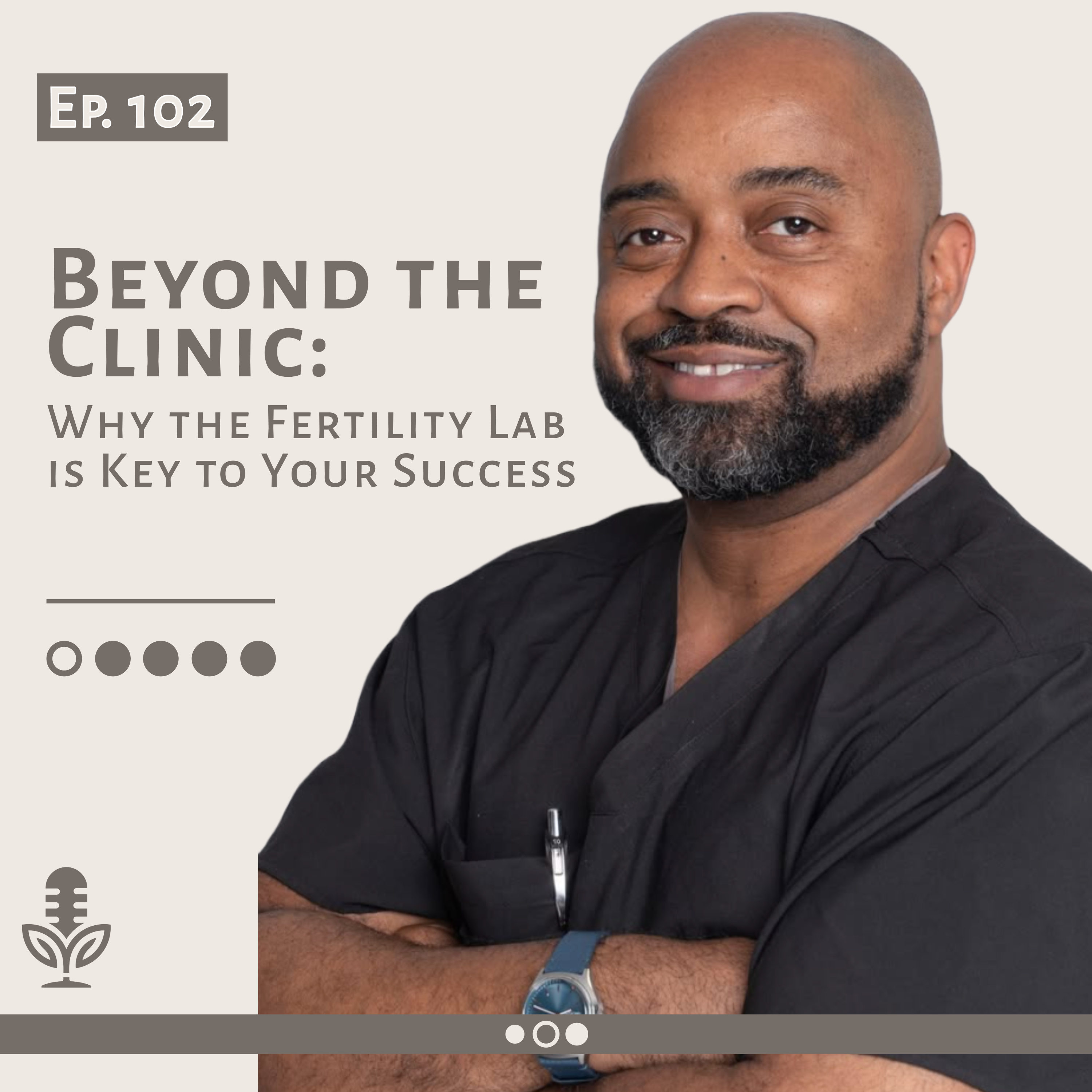
The lab is a critical part of the process, but it's not something most people know much about. That's why I'm so excited to have Kenny Smalls joining us. Kenny is a director of laboratory services at Global Fertility and Genetics in New York, and he spent years perfecting the science and technology behind the fertility labs.
From maintaining the ideal conditions for embryo development to working with cutting edge innovations like AI and time lapse monitoring, Kenny has helped countless families achieve their dreams of parenthood. In this episode, we're pulling back the curtain on what happens inside the fertility lab. We'll talk about why it's so important. How lab conditions can impact your treatment and. And what you should look for when choosing a clinic. Whether you're just starting your journey or you're in the middle of treatment, this is information you don't want to miss.
Welcome to the Fertility Cafe, where we explore the beautiful complexity of modern family building.
I'm your host, Eloise Drain, and this is a space for honest conversations about surrogacy, egg donation, and the journey to parenthood. With expert insights and real stories, we're here to guide you through the medical, legal, and emotional aspects of third party family building.
We believe that love has no limits, and neither should parenthood.
All right, well, Kenny, welcome to Fertility Cafe. Thanks for joining me.
[00:02:09] Speaker B: Not a problem. My pleasure.
[00:02:10] Speaker A: Awesome. So I always find it fascinating to hear how people find their way into this field. So let's start with your background. And how did you first get into the world of embryology and laboratory science?
[00:02:24] Speaker B: Oh, my background? Let me first give a shout out to HBCUs. I went to Morgan State University, graduated 1990. When you graduate from a college with a biology degree, you want to accumulate some volunteer hours before you decide if you go to medical school or not. So I was picked up at a research clinic at Cornell in New York City, and I had a great mentor. Yeah. Let me first say the best thing to have in life is mentors. Mentors are the best thing to have. I cannot stress that enough to really get ahold of someone young in the science field and become a mentor to them, because mentors really helped me out. I had a great mentor who was the head of Immunology named Dr. Steven Wicken over at Cornell. We were testing for the early parts of chlamydia. PCR testing, it was like being basically a lab rat and checking for antisperm antibodies for guys who were getting a lot of vasectomy reversals back then. So back in the early 90s, a lot of guys were getting vasectomy reversals.
So you figure that in the 70s, late 70s, early 80s, everybody's getting vasectomies. Somehow somebody, I don't know if they remarry, whatever. Now they give vasectomy reversals. So you do a vasectomy reversal. You have antisperm antibodies, and those anti sperm antibodies can kill the sperm off before it penetrates an egg.
So we started doing testing with anti sperm antibodies and reproductive immunology and doing all this testing. As I was thinking about applying for medical school and doing my MCATs and all of that, the feel of fertility was just starting to grow. And he told me that if you study this field of infertility, you will not have the burden of having so much with your cost of medical school. And this is a new, exciting field that is really starting to pick up because they're doing some new and new innovative things in it. So I kind of latched onto it. And oftentimes, for at least for the first 10 to 15 years of me doing IVF, I was always the black. The black guy in the room always.
So that was really like, you know, a, you know, an eye opener that I'm so used to being in a room where it's just me to that color. I. I'm happy to report now that, you know, when I go to these conferences now, I see a lot more of us in there. So that's a great thing. You know, you see. You see progress.
So my mentor told me about the field of fertility. So I studied that. And then this. My second mentor in my life was Jock Cohen. Jock Cohen really opened doors for me. He was head of the IVF program at Cornell, but then he went over to St. Barnabas Medical center and opened up the program over there.
And I joined over there my Russian mom, Elena Keson, who was in the field of ivf. She was one of my first teachers. Artists can be, but she taught me everything. Learning under her and then getting a job. Cohen, that really just set a major trajectory. What I was able to do and when it came time when they started to offer a master's in clinical embryology, there was only like two schools in orphan at the time.
One was Virginia down EVMs down in Virginia, and the other one was where IVF came from out at University of Leeds. When I wanted to apply to Virginia, Eastern Virginia, JOC told me I was going to Leeds and I said, I don't, I don't want to go to Leeds.
I want to go right down the turnpike to Virginia. And he was like, nah, nah, you're going to Leeds, you want to learn, you go to Leeds. So come with the leads.
And it was a great experience and I became the first African American to achieve the degree of clinical embryology from over there. So. And since then the doors have been open for a lot more people of our color and to go over to school and University of Leeds and really get the historical aspect of ivf, was able to train under some of the teachers who was a part of that initial program with Luis Brown. So it was a great eye opening experience.
A bit spooky at times. Cold and rainy over there all the time when we were over there, but being over there, it was contingent upon being with an IVF program. So I was at St. Barnabas at the time and two and a half years back and forth between here and the uk it was a great experience. I do remember one funny but not funny story is that when I was over there one time is when they started to bomb the tunnels. They had those bombers in the tunnels. And my mom was like, I don't think I want you going over there anymore.
I'm like, might be fine, be fine.
[00:06:45] Speaker A: Rightfully so.
[00:06:47] Speaker B: And she was like, yeah, Kendall, I think that might be it for you, going back over there. I'm like, no, yeah, fine. So. But now. But it, it worked out, you know, you know, mother's love, you know, it worked out and, and I was, I just stayed on a trajectory of having these great mentors at St. Barnabas at the same time. Is that, you know, one of my mentors, Dave Sable, at one point at St. Barnabas. Dave. And I was only guys there, that's how bad it was. But those and those snowstorms, him and I both driving from New York City out to Jersey.
Dave had a pathfinder, so I was just right behind him and my little infinity as we plowed through the snow, you know, but these mentors, and of course Mina, I had great mentors that showed me not to be afraid, right?
[00:07:32] Speaker A: Yeah.
[00:07:33] Speaker B: Not be about mistakes, but also be able to be confident in your work and in your ability. Because there's sometimes you will. You will work with your. Your colleagues or even your superiors where they are doing the wrong thing. And you have to be able to be confident in a delivery. I haven't learned a delivery just yet on telling superiors that they're wrong in something.
All I know is straightforward. I got to work on that. I got to work on it. I know I do. But they gave me the ability to say, okay, something's wrong, something's wrong, you know, that's it. And be able to go into an IVF laboratory and if there's a problem with, you know, fertilization, excuse, whatever, be able to map out, you know, just the basics and be able to find what's wrong with labs.
[00:08:18] Speaker A: Well, and I think too, that that is one of the things that is important because obviously the reason for this conversation is being able to talk about fertility labs. Because so many people, they think, oh, I'm. I have infertility, or I. I'm doing surrogacy, or I'm doing egg donation. I automatically need a fertility clinic. And, you know, I see this shiny website or I see this success, and so I'm just going to jump to this fertility clinic without really thinking through that. There is a whole other piece of a fertility clinic. That's the lab that's on the back end, that actually does all of the work, really.
So let's talk about what happens behind the scenes. Can you walk us through what goes on in the lab from the moment the egg and sperm arrive?
[00:09:09] Speaker B: We usually start up early morning with the retrieval. Right. That's where the oocyte aspiration. But even before that, we like to take a look at the husband's sperm, see what we're actually working with. Because one of the misconceptions that patients have about IVF is that it's a female problem. That's one of the biggest, biggest thing. That's a female problem. It's not. It's both of us. It's both. It's 50% on each. So even though you can. Like a great example is this, at one point, we had a guy come in with his wife and they were doing through infertility. He had two kids already. He had two kids. This is his second, second marriage. At every meeting, he would come into the clinic, he was always berating her about, this is not his problem. This is your problem. He's only here for her. You know, he's only here for her.
So we told this guy, he said, Listen, Mr. So and so, we, we understand this, but we need to do a semen analysis. We can't do anything without semen analysis. He refused to do semen analysis because he said he has two kids already.
You see, we understand, but in order for us to check up all the bases here, we have to do semen analysis. We did a semen analysis. There was no sperm. So there was no sperm. Went back to the, to the doctor and to the patient. I'm so and so. We would like to repeat your semen analysis because we want to make sure that. And double check, just. And he. Again, he berated us again. And this woman was sitting next to him crying every time because he was, you know, extremely rude. He was really rude that he had two kids and he shouldn't have to do this. We did the test again.
Still no sperm.
So now the doctor has to say, Mr. So and so, I understand you got two kids, but our records indicate you have no sperm. He said, what do you mean I have no sperm?
I've got two kids. Mr. So and so, there's no sperm here. He says, what are you talking about? I see my sperm all the time.
Mr. Song. So you can't see your sperm. You see seminal fluid. You don't see your sperm, sir.
So then it clicked to him that he doesn't have sperm. So now he starts being really irate.
And now. But that same woman who was sitting next to him who was crying is not crying anymore because she realizes it's not. It's not only on her now.
So now he starts screaming how he's not going to be paying child support anymore. And I'm like, sorry, Mr. So and so. Once you claim someone in the state of New Jersey, they're yours.
There's nothing you can do about it. Yours.
Oh, he was sick when he left out, you know, he was completely sick.
[00:11:39] Speaker A: Yeah, but I can imagine.
[00:11:41] Speaker B: Yeah, yeah, he was. Oh, he was sick. She was a lot better. But he was sick because he, for, for the first three or four months, he just berated her about he couldn't take time off from work.
He had to do this, you know, to do this thing with her. He's got two kids already. It's not my problem, it's your problem. So you should just be coming here, just completely nasty.
So that is the one thing I always tell couples who are seeking ivf, because lots of times the women will come in by themselves.
You know, the guy initially don't want to come. They were like, you know what you Go, I don't have a problem. And I understand it's a bit of an embarrassment thing too.
But we.
No IVF clinic should treat a couple for infertility unless they do a semen analysis on the husband off the rip.
If they, if they want to go right into treatments of the female, that's a problem.
[00:12:40] Speaker A: Well, and not just in dealing with infertility. I think anybody who's considering and need IVF because they want to be a parent, lgbtq, single male, whatever, needs to do a semen analysis. Because you, you don't know.
[00:12:56] Speaker B: Don't know. But there are so many. I mean, to take the first initial steps to seek fertility treatments, you have to have a strong partner that's willing to go that journey with you. If you don't have a strong partner who's going that journey with you, you'll be at these doctor's offices by yourself.
By yourself.
And that's male or female. So there has to be a really come to Jesus moment about, do we need to seek professional help and not just Dr. Google.
Because a lot of women go to Dr. Google before they even do any kind of IVF treatments. They go to Dr. Google. And for women who go to Dr. Google, please, please, please, please stay away from those IVF clinics who say, pay for three IVF cycles and get one. Bait and switch, crazy 80 back in the day about paying for all these IVF cycles up front.
Our goal in IVF should be to get you pregnant on the first try, period. Hands down. You should not have to pay for three or four cycles of IVF in order to, like, you know, limit the cost. The IVF clinic should always go for that one time, one shot.
When I first learned ivf, our goal was always, we want one sperm, one
[00:14:17] Speaker A: oocyte, one baby, three or four, or this is a guarantee. And if you don't get pregnant, you get your money back.
[00:14:24] Speaker B: Yeah, stay away from that. Stay away.
Stay completely away.
Stay completely away. Because to me, it's like you're telling yourself to tell the patient, like, oh, if you have to come back, we're going to be charging you more and more money. Well, you shouldn't survey greatest thing of insanity doing the same thing twice over and over again and expecting different results. So unless you are changing up what you're doing from IVF clinic standpoint, I mean, there may be a decision has to be made that we can't use a patient oocytes, that you have to do donor sperm or, I mean, donor oocyte or donor sperm. These things would be a process of change.
Every time there's a failure in the IVF cycle, what are you going to do differently? And that's a moment and a situation that the patient, the couple sits down with the physician and he goes over what the cycle was like, where he could have seen that there wasn't a reason why there wasn't enough blastocyst. And what could be done differently on the next time around?
Because sometimes some doctors just tell you, oh, just try again. Let's see what happens.
What are we going to do differently? Oh, nothing, Just, just try again.
[00:15:33] Speaker A: Right, right. Yeah, yeah, yeah, yeah, yeah.
Which is, yeah, ridiculous. So what are the, what are the key factors in the lab, like air quality, temperature. Temperature or equipment that can impact embryo quality and development?
[00:15:50] Speaker B: The major, major, major impact of embryo development is air quality. Air quality.
You would be surprised how air quality is a major, major factor in embryo development.
Major.
So you can have, you can have a laboratory with the brand spanking new machinery and all kinds of bells and whistles. If your air quality is bad, that's better for everybody. So that's why we have different kind of monitors. Well, pollutions, pollutants, let's say you get a brand new kitchen, right.
You unpack the appliances. There's a certain smell with that. We call it new car smell or new appliance smell. Well, those smells are bad. Smells are bad. And it's funny when, you know, working with women, sometimes they like to put in the extra perfume, like, nope, not the lab. Because if I start to smell it, then it could damage air quality. I don't, I'm not really so much on their nails anymore. I used to be, you know, years back when they had the nail color and the polish and all of that. I'm a lot better now with that. So.
But there is, there are. Yeah, yeah. You had to like, look, come on. Like this is nail polishing, this chipping, whatever, you know. But there are air monitors that we have across our laboratory that will alarm if there is a certain kind of fragrance or shifting in, in the air quality. Measuring the VOCs, even like with like, let's say in a lab is fine, but two, two doors down or two rooms now, they're painting.
Well, we have to make sure we shouldn't be doing any kind of painting anyway. Around the IVF laboratory there should be a ceasing cycles and until all that's out. But the, the paint we must be able to look at to check the VOC meters of that paint because there's a lot of VOCs in the. In paint. And it's a certain kind of. Is a certain kind of paint that we would use in the IVF laboratory to limit the amount of VOCs that could be. That can be around in the.
In the laboratory. Now, ironically enough, one of the other things that can happen is actually what happened to us about three years ago. So we're in an office building in New York City, and about four years ago, there was a spa, like one of those. Those spas with a lot of pools and stuff that was on, like, the sixth or seventh floor, like three floors above us.
Right. A spa. Well, somehow some way, the plumbing was damaged and the floors was flooded three floors down.
So it was all flooded throughout to our IVF laboratory.
But our floors are porcelain, so it's like the garage. Like the garage floors. So when the water hit our floor, instead of it going through, it just rose back up.
So we had to. Once we got the water out, the doctor said, okay, well, Kenny, the water has been drained out. We can start seeing cases by next week. And I'm like, no, we cannot.
But the water is gone. I'm like, no, we have to strip each wall down to the brick to check for any kind of moisture, because if there's moisture in those in that wall, that can breed fungus, which is not great for an IVF laboratory. Spores, mold, all of that.
So when you have any kind of, like, water damage like that, it's best to strip it down to the brick. And once you strip it down to the brick, you bring in almost hype, the highest powered air dryers. I mean, like, construction size. And I let that blow out for like a week.
So I was able to build a lab back up, but it took about a month instead of a week.
So. So water damage, it could be. Yeah, it's terrible water and the gains, the air quality. So it could be something that we don't see or smell, whatever, but it's already out there. So next thing you know, you have a lot of vacuums in your embryos. You see a lot of fragmentation and the development of embryos. So you're looking at as though it's got to be some air quality, the first thing you look at.
[00:20:10] Speaker A: And you know, and the craziest thing, though, that again, people don't even realize that this is even a thing. Nobody talks about it. Nobody is educating anyone to talk about.
Yes, your reproductive endocrinologist might give you a diagnosis and might tell you, okay, these are the steps that we're going to do. But Nobody actually talks about.
But then when it gets in the lab, the importance of that embryo and how that embryo is taken care of and what process that embryo is going through and all of those specifics, right?
[00:20:44] Speaker B: Because again, you just.
There's a lot of what you can't see, feel, smell or touch. You know, it's those things that you. But you don't realize it's there. So you have to be able to have positive pressure in your laboratory where it's constantly pushing out, pushing out the negative pressure, constantly pushing air through. Now, also being in New York City, you know, our exhaust, our H vacs are out to 57th street, so you can get congestion at any time.
So those pollutants are in the air, just spiraling through. That's why all IVF centers have to have their own separate H VAC system where they have the different kind of carbon filters to filter the air through to make sure you have the best quality air in that laboratory. So the H vac system, and this is just something that you have to do with it, with the idea of clinic, you gotta have a strong H vac system that's on its own, away from your regular normal office hours.
Air and AC in your units has to be totally separate, totally separate.
[00:21:52] Speaker A: So patients often hear about embryo grading. Can you explain how lab conditions influence those grades and what they mean for success rates?
[00:22:01] Speaker B: So when we do an embryo grading, we're basically checking for the ICM in the cell mass, the trifectoderm, and of course, the size of the growth of the embryo.
So some facility clinics use a ABC grading system. Some do the 1, 2, 3.
We use a David garden system in our clinic where we do size of the embryo. Then it's ICM intractoderm grading A and B from there.
So the grading system, again, it varies from clinic to clinic, but everybody wants to get to that blast somewhere along the line. You labor an embryo blast at some point. So what is that? Is that a five or is that a B? You know, as B as in blast. So it depends on the clinic, really, the scientific director, what size they go to. But we go with the David Gardner method.
[00:22:57] Speaker A: I'm assuming an A grade embryo versus a C grade embryo is going to be better and it is it going to be that for sure that a grade embryo is going to take and become pregnancy, or is the C grade embryo going to take and become a pregnancy or does it matter?
[00:23:16] Speaker B: It depends. It depends. Ideally, you want to transfer A grade embryos, but I've seen some bees, even some Seeds that have made, you know, healthy children. It really depends on stuff that we really can't touch, to be honest with you. We don't have that ability to, ability to manipulate. It's like we have to fertilize the oocyte and this is, and then this is what we have. Now everyone is, is moving towards PGT testing, doing a biopsy on the embryos, which I think is a great, probably it's the best way to go right now.
And what we've been doing is that we, most IVF clinics, if not all, even if you do a embryo testing on an embryo, we wait a month or two before they do the FET to make sure their lining is back in place. So it's always best to, of course do pgt, but you don't have to. It's not like, you know, you have to unless you have some kind of genetic abnormality to try to pinpoint.
But even if we do a regular IVF cycle, we still freeze everything.
We still freeze everything.
[00:24:24] Speaker A: Can you explain what the PGT is and how that works?
[00:24:29] Speaker B: So, yeah, PGT testing is basically biopsying the embryo from the trophectoderm, some cells that can be siphoned off by laser and sent to a PGT clinic to measure for any kind of genetic abnormalities.
Now, by the way, you test with genetic abnormalities, the PGT clinic will be able to tell you what the sex of the embryo is.
So lots of times we have a lot of European patients and the patients from Asia. And whereas sex selection is not legal.
So if they come over here to do the whole PD testing, they have everything mapped out for them, Sex selection, euploid and your ploid embryos and be able to determine what they want to transfer.
[00:25:18] Speaker A: I mean, technology is like amazing because just to think of, you know, 40, 50 years ago, which was not a long time ago because I was still alive, and how this stuff didn't even exist, you know. So yeah, now no. And now fertility labs are adopting incredible new tools from like AI to time lapse monitoring to, you know, how have these technologies changed the way labs operate?
[00:25:56] Speaker B: So time lapse from a personal standpoint, time lapse for me has been great because now that I have to break my ass to get here at a certain time in the morning to check for fert. So you can easily, I'm just being personally, this is what it is. So you can always rewind back and see actually when fertilization has taken place. So also with that, if you put in your own kind of annotations in the embryoscope, you can have it pinpoint for you when two pronuclei have shown up in case some, some doctors may want to know that. And measuring the development, it's a superior incubation system because again, the less you touch the embryo, the better.
But we still change media because we realize that the wells that the embryo sits in and the embryoscope is really, really, really, really small.
So you constantly have to put in fresh media into those drops or change up those dishes altogether to increase your development rate. Because again, the embryo can use up a lot of those, a lot of that media in a short period of time. So the embryos are in a media with protein assistant, basically more than a serum. It's a media that's used to develop the embryo. So we try to mimic the, what goes on inside your body as much as possible.
So it's filled with the same kind of nutrients that a woman would use to nurture an embryo. But it's only up for x certain amount of days before you really need to get it back and get into it, into a mother. The media that we use, we use is this scientifically created kinds of media to help enhance the growth of the embryo and these nutrients from the media to help the embryo grow. So if we had. But again, if you have that very, very small well on the embryoscope where the embryo is placed inside, it's going to use up a lot of that, the nutrients needed for its growth pretty quickly. For what we've learned is that group culture, which is putting it into a, a field where there are other embryos with it. You know, to, to me, I kind of like group culture that's putting more like three, four embryos in the same drop. Because I do believe that it's just my own thinking, I do believe that it has a better growth potential when you put it in group culture, I
[00:28:25] Speaker A: guess as part of this, you know, media and all of that.
What about the vitrification process?
[00:28:32] Speaker B: So, vitrification process, that was actually my thesis for my, for my masters. So I learned to freeze oocytes and embryos on a grid strain flat surface. I learned. So when I, we first started doing vitrification years ago, it used to take three hours. And that came with inducing crystallization to the embryos until the straws that I was frozen in. And it used to be this, this machine that would make this annoying sound like, like it's at a steel mine, just clack. And it was so loud and it was so long, and it always seemed to happen to me on a Sunday when I want to watch football, but it was so long and so loud, and it took three hours.
Three hours.
Now vitrification takes like eight minutes. So it's to me. To me, Danby, Dan, Dixie, AI. All that vitrification is what got me. You go from three hours to eight minutes.
That's.
To me, that's one of the better things. Revolutionize ivf.
[00:29:51] Speaker A: Yeah. Now, is it the same process if you're freezing embryos versus freezing eggs or freezing sperm?
[00:29:58] Speaker B: No, it's a different process for each different process.
Sperm is a lot tougher than embryos and oocytes and embryos are more tougher than oocytes.
So the oocytes are way more delicate to freeze than an embryo, and the embryo is more delicate to freeze. In the sperm cell, we do a lot of. With sperm, we do a lot of vapor freezing. So we want to initialize temperature changes to the embryo because the embryo has their own test stroke buffer. I'm not the embryo, but the sperm has this test stroke buffer that we use for protecting of the sperm.
For the embryos and oocyte, there's a system of getting the water out of the cell and at the same time getting alcohol or cryoprotectants into the cell to protect the cell. So it's like a crisscross highway of fluids in and out of the cells of oocyte and embryo. So you have to move it to different stages to reduce the amount of water in the cell. But then when you saw you go into different stages to add water back into the cell to re. Expand it. So as you're freezing, it's going down like this.
Your thawing is opening up like that,
[00:31:05] Speaker A: obviously, with all of these processes and everything else.
You know, a couple of years ago, there was clinics that their lab, I don't remember if it was destroyed or something happened to the lab, which obviously happened to all of these for embryo. And that's right. How does a lab make sure that those things don't happen? Like, what do you have to have in place? What do you do?
[00:31:32] Speaker B: Like anyone. For anyone that there's a tank malfunction that can, you know, rare, but can happen to have a tank that's totally dried out, that means it was never checked for days or weeks.
So every IVF clinic will usually check every day with a rubber stick to measure the depth of the liquid nitrogen in a tank. And there are some cryo companies out there now that are ma that are measuring the actual weight of the tank. Now, a cryo tank that holds thousands of specimens. It's a pretty heavy tank with some nitrogen inside of it. But now they're, they are new companies that would attach kind of like a claw to the side or underneath the cryo tank and would measure the, the inside of the tank through infrared structures. Inside of the tank, but also monitoring the weight of the tank. So if a tank is full naturally it's a certain weight there. But they're usually on these trolleys or like five wheel crates that you move around. You can't pick up the tank.
But these new mechanisms right now are actually measuring the weight of the tank. And of course, the lighter the tank, meaning that the nitrogen, this nitrogen being evaporated out of that tank so they can check for evaporation and see how fast it's losing that nitrogen.
So there are new things out there now that are actually measuring the tanks. Yeah.
[00:33:01] Speaker A: Okay. To make it more protected.
[00:33:04] Speaker B: To see, just to check it, to check it. To see if the level, the levels of nitrogen are going down too low.
Because even if you move a tank around right now, it's the same size as almost a full tank. But if you're not measuring what's inside of the tank as is, plus the weight of the tank, you know, where you're looking nitrogen levels are. It's better to, to know exactly where the levels are. The tank. Checking the temperature in the tank, which should be about minus 170, 170 somewhere around there, and monitoring to see if there's any fluctuations or changes in that temperature.
That temperature is starting to skyrocket, you know, a little too quickly within a two or three hour radius. Then you start to wonder about what's going on.
[00:33:48] Speaker A: So one of the biggest developments in fertility science right now is the creation of embryo models for stem cells.
And the models are sparking debates about their ethical implications and potential uses.
What's your perspective on the research?
[00:34:06] Speaker B: I wouldn't say I was a fan of it. I think from our personal standpoint, we have to leave some stuff up to chance.
I don't know if you remember there was a few times a few years ago they was trying to remove pronuclei from a young donor and putting her pronuclei into an older woman to see if that could help develop the. Yeah, no, no, yeah. There's some, there's some things you, you have to leave to chance. That's just from, that's just from our standpoint, that's just my standpoint. I understand that there are people out here who are trying a lot of things. And that's some is great for science. It's great for science, but at some point we have to like, say, okay, okay, we're not doing that, but I understand how some guys want to do it, but yeah.
[00:34:53] Speaker A: So how do you balance the push for innovation with the need to stay within ethical boundaries?
[00:35:00] Speaker B: I still believe that the less you touch the oocyte and embryo, the better. The less, the less you touch it, the better. I'm a firm believer of that. Now with the advent of AI, everybody's throwing AI AI. AI. AI is really pictures and images, pictures and images for the most part. Now there's a few programs out there where you're able to tag a sperm where that shows that's supposed to be the most normal sperm in the grid. And I think that way, that way is, is a better way of choosing those sperm cells for men who have severe male factor that would help them get a better development from an embryo.
So, yeah, those, those AI programs that you're able to like as a kid, it's like you're playing space invaders. You're trying to tag the best sperm. I think those kind of programs are great, great. It will really help male factor.
[00:35:56] Speaker A: But what about on the egg side?
[00:35:58] Speaker B: There was, there was an oocyte planted as well. Again, it's the ability to tag the best O site. You know, what's, what's the best. It's not just, you know, from a visual standpoint, you know, what are the qualifications of historically normal osi. And that information is fed into a program, and that program is used to look at a fresh oocyte to see if it has the same qualifications of a normal ociding and if that's. And that if that's good. But again, from oocyte standpoint, they really want to go with an embryo. So you're looking at the best embryo. The embryos are what's really going to be tagged more than the oocyte. Because the oocyte will be as is until you fertilize it. You don't care about that. It's as is. But when that embryo is developing, when the embryo is made, then you want to tag the embryo. So what has the best numerical aspiration of becoming a normal implanted embryo?
So you're looking at that, that embryo and you're running through the modifications of the, of the images and the size and instruction, all that stuff would be able to tell you, you know, if that's going to the chances of implanting again, it's always a Chance of implanting, Right. Not that it will implant. It's the chance of implanting. Right?
[00:37:17] Speaker A: Yeah. I. I mean, you know, I always tell people there's. There's a guarantee that you can have an embryo transfer, but once that embryo is transferred, no one has any control of that. That is up to God and God alone.
[00:37:32] Speaker B: Yeah, yeah, yeah, yeah, yeah. There's something. You gotta leave it to God. There's. You just gotta leave it there.
Yeah. Take it to the Lord and leave it there. Take your burdens.
[00:37:39] Speaker A: Right?
[00:37:40] Speaker B: Yeah.
[00:37:40] Speaker A: I mean, you know, all hidden in the secret place that no one has control over. I mean, once the doctor transferred into it could be the most amazing uterus, that golden uterus. It does not matter.
[00:37:53] Speaker B: Doesn't matter. I think the one that, that gets me is that when I have guys who want to. Who want to use a donor, and they look at the donor and I'm like, oh, she's beautiful. She's gorgeous. I want to use her. I'm like, but Mr. So and so, you use it before she has low ovarian reserve. I don't care, Kenny. I don't care. I want to use her. She's gorgeous. And they get one or two oocytes. They look at me like, kenny, what happened? I'm like, dude, I told you this is what's going to happen. We have already run the test. She's already come through our process already. She's already done a retrieval with us. Lower gravity reserve. Not always the exterior. What goes on inside?
[00:38:31] Speaker A: No, absolutely. What quality control measures should patients look for in a fertility lab?
[00:38:38] Speaker B: I don't know if it's a thing for the patient to look for quality control. I think they would.
First off the bat, we all report to, like, government agencies. So we report to the fda, we report to sart, Society of Assistive Technology. So there are government agencies, structures and guidelines. Even with CAP and jaco. So we have to be affiliated with one of those things. And with sart, it measures every oocyte that we've gone through the process. Every embryo has a beginning and an end. So the government pretty much has a structure. And in New York State, which has the most stringent of laws, if you have a tissue bank license, you have a SART license, you have a CAP license. Those are the things you need to look for in laboratory. Those are pretty standard. It's pretty standard. And more importantly, everyone has to have a reporting agency. You know, what do you do with those O sites? What did you do with those oocytes? Ironically enough, just this week, we just had a surprise FDA inspection. They come in, they flash a badge, show us your records.
There's nothing you could do about it. It is what it is.
So these kind of testing measures and quality assurances is what helps the patient be more comfortable, if anything, with any area of laboratories. And then because public knowledge of it, if a lab is shut down for any reason, it becomes public knowledge.
[00:40:00] Speaker A: Right, Right. So is there certain certifications or accreditations that matter most?
[00:40:05] Speaker B: Gotta have a tissue bank license. If you don't have a tissue bank license, every lab. Every lab has it. If they only have it, it's a problem.
Tissue bank license, then you have to have different reporting structures, government reporting structures. Who do you report to? For every outcome of every IVF case, nine times out of 10 people report to SART or NASS, which is the CDC.
So you got to be able to report to one of the two of them, if not both, about every outcome.
Patient information, everything should be uploaded into their system so that the patient or anyone else can go back and. To see and check what's going on with your laboratory. But there's a mandatory reporting mechanism for all IVF clinics.
[00:40:52] Speaker A: Would that be something that patients can access?
[00:40:55] Speaker B: You can see it because I don't even access it. But you can, you can always ask a doctor if you are. If the license, if the lab is accredited, most. And most doctors will not be in any way. It's not accredited. But in most IVF clinics, we have to have our licensing out for the public to see.
So as you go past an IVF laboratory or whatever, in the doorway, you see a tissue bank license, you'll see a CAP license. You see those licenses outside your, Your, your IVF facilities, labs.
[00:41:24] Speaker A: So what makes a great embryology team?
[00:41:27] Speaker B: You need one person who's anal.
[00:41:31] Speaker A: Is that you?
[00:41:31] Speaker B: I'm trying to tell you. No, that's not me.
[00:41:33] Speaker A: I'm.
[00:41:34] Speaker B: No, no, no, no, no, no, no. That's not me at all. I'm. I'm. I'm. I'm old in their eyes. I'm old. I'm a. I'm a dinosaur. But I said, I tell her it's okay for me to be a dinosaur, but, but I'm a T. Rex, so it's a difference. I'm not a big slow one. I'm a T. Rex. So everybody should be attention to detail. You gotta have flexible embryologists because our days fluctuate. So on my team and my staff, I put my staff on four day work weeks. You come in four days a week and it can be as, as structured makes it, but four day work weeks has worked better for me for a five day work because sometimes you have to cover a weekend. I put myself on four day work weeks.
A lot of tension and stress. The team also has to be flexible because you may have one day with one, the next day with seven, next day with four, next day with three, next day with eight. So you have to be flexible and be able to watch the schedule and be able to know that, you know, no, I'm not supposed to work, but I can come and help the team out if I need to go and help the team out. So everybody's schedule has to be flexible. The hand, the hands on the training. Sometimes embryologists, I'm probably getting some hate mail about this one, but sometimes embryologists think they can do like a high end procedure like IXI for like a month and then, and then command maximum salary as if they've been doing IVF for like 20 years. So you ask them like, you know, okay, but how long you've been doing icy? Oh, I've been doing it for like two months now. Like, well, how much you want? How much? I want150,000. I'm like, dude, right here. So.
[00:43:04] Speaker A: So embryologist is not an MD.
[00:43:07] Speaker B: No, no, it can be. They can be MDs, but they're not MDs. Not most time. Are not MDs.
Most time. It's. It's masters.
It's masters and some kind of a biology. It's masters.
[00:43:20] Speaker A: Okay. Okay.
Well, we are. We've run out of time, Kenny. We have run out of time. So I thank you so much for joining and sharing your expertise. And it's. I know it's easy to focus on the visible parts of the fertility treatments, the doctors, the medications, but I think this conversation has really highlighted how much happens behind the scenes in the lab.
Before we wrap up, where can listeners learn more about global fertility and genetics and get in touch with you if they have questions?
[00:43:52] Speaker B: GlobalFertility.net you can look us up there. We're right in New York City. We specialize in all kinds of ivf. We do a lot of third party. We do a lot of same sex couples. We believe love is love and love is global. We are always trying to help. Family building, that's our number one journey. That's our number one care. No one's like cattle or a number here. Everybody gets a personal specialized treatment.
[00:44:15] Speaker A: Amen to that one.
Thank you for joining me, Kenny. I appreciate it.
[00:44:20] Speaker B: All right, all right. Take it easy.
[00:44:23] Speaker A: Thank you for joining us at the Fertility Cafe. If you found value in today's episode, please subscribe, leave a review and share with someone who might benefit from this information.
You can find, show notes and resources from this episode in the description, or visit the fertilitycafe.com for more information.