Episode Transcript
[00:00:00] Speaker A: There's a kind of waiting that a.
[00:00:01] Speaker B: Lot of people don't talk about.
[00:00:03] Speaker A: Waiting for answers, waiting for something to work.
[00:00:06] Speaker B: Waiting for the phone to ring or the test to come back. Waiting for your body to cooperate.
[00:00:11] Speaker A: Waiting for your life to start moving forward again. For anyone going through infertility or trying to build a family, that kind of waiting can take over everything.
It's not just the waiting. It's the trying, the loss, the wondering how much more you can handle and still finding a way to hold on to hope.
Welcome to the Fertility Cafe, where we explore the beautiful complexity of modern family building. I'm your host, Eloise Drain, and this is a space for honest conversations about surrogacy, egg donation and the journey to parenthood. With expert insights and real stories, we're here to guide you through the medical, legal and emotional aspects of third party family building.
We believe that love has no limits and neither should parenthood.
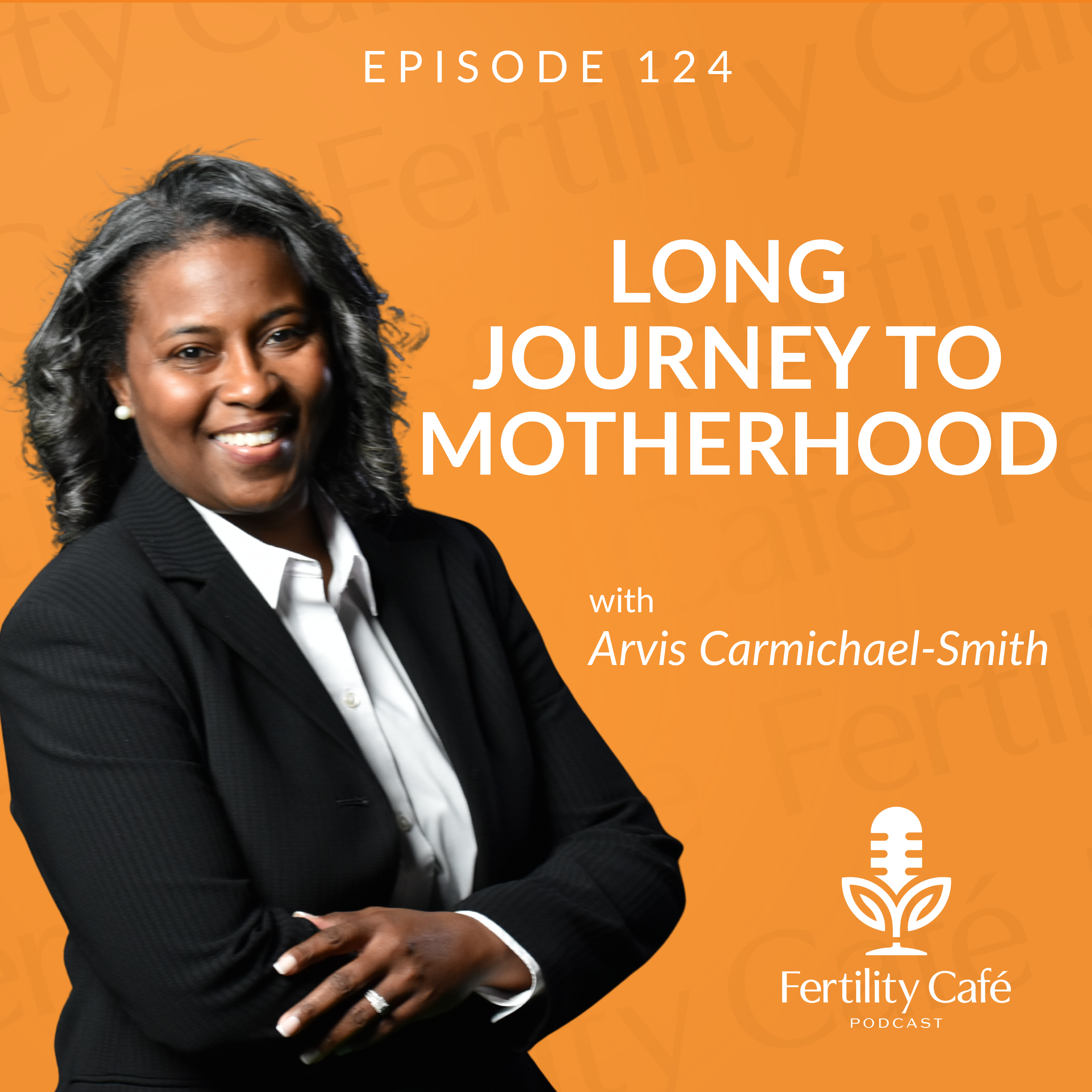
Welcome to Fertility Cafe. I'm your host, Eloise Drain. If there's one thing this show continues to remind me of, it's that no two paths to parenthood look the same. Some are straightforward, some take years, some are filled with unexpected turns, and most don't go the way we planned. Today's guest is someone you may remember. Arvis Carmichael Smith joined us back in episode 87, and her story stuck with so many people. She shared what it was like to spend more than two decades trying to build a family through fertility treatments, pregnancy, loss, adoption, setbacks, and all the grief and hope that came with it. When we last talked, she and her husband were getting ready for what they believed would be their final attempt, one last transfer. She didn't know how it would turn out. None of us did. But she was willing to try one more time.
Now she's back, and this time things are different.
[00:02:02] Speaker B: Let's get into it.
[00:02:03] Speaker A: Well, Arvis, I'm glad you're back. Thank you so much.
[00:02:06] Speaker C: Hi, Eloise. Long time. Thank you for having me back.
[00:02:10] Speaker B: I know, I know. It's good to have you back. So before we dive into everything that's happened since we last talked, would you mind sharing a little bit of your story Again, just to bring listeners up to speed who may not have heard your first episode about what you've been through over these years.
[00:02:29] Speaker C: Absolutely. Thank you.
So I guess to start things off, what catches most people by surprise is I am now 52.
I've been married for 25 years. My husband and I, we had been trying for several years to start a family, and we had not Been successful. We tried traditional methods. We tried ivf, and we would kind of get to a certain point, and I just would not be able to sustain the pregnancy.
So us deciding to have a family is not something that we just started talking about.
This has been an ongoing desire for the both of us for about 11 or maybe 12 years now.
It's been a really, really, really long time.
[00:03:20] Speaker B: So in your process of you guys trying all of these years, remind me, how many miscarriages have you had?
[00:03:27] Speaker C: It's been six miscarriages.
[00:03:31] Speaker B: And you guys have done how many rounds of ivf?
[00:03:34] Speaker C: We did four rounds of ivf.
And with all of the rounds, I would get pregnant, but I couldn't sustain it.
And actually with one of the pregnancies, I was actually without any assistance. So it was just old school.
I just up and got pregnant, which I was really excited about. But unfortunately, I wasn't able to sustain it.
[00:04:01] Speaker B: Did they ever know why?
[00:04:03] Speaker C: So initially, the practice that I was with was not able to pinpoint why. I was simply told it was low ovarian reserve.
But the underlying cause, we were never really able to, at least from the first practice that I was going to.
[00:04:22] Speaker B: And so you obviously then change practices.
[00:04:24] Speaker C: Yes, I did change practices the first practice. I stayed there perhaps maybe two and a half, three years because I was still very much hopeful.
Had a lot of faith in the practice, in the doctor, in the team, actually.
But my husband and I made the. Made the decision to just try a fresh new set of eyes and everything.
[00:04:52] Speaker B: And then when you went to that practice, what happened?
[00:04:56] Speaker C: So when I went to that practice and shared with the doctor the struggles that I'd been having, she basically did like, a complete physical exam.
And it was not just like in one visit. It was over, you know, several visits because she wanted to make sure that she didn't miss anything.
And there was like, a battery of questions that I had to answer and additional testing that needed to be done.
She was eventually able to get to the root cause of me not being able to sustain the pregnancies.
And it was.
[00:05:33] Speaker B: And what did they find out?
[00:05:34] Speaker C: It was actually a thin piece of tissue that was blocking. It was, like, considered a blockage.
And the pregnancy process or procedure for her to remove that, believe it or not, it was about 15 or 20 minutes.
So I was relieved. I was upset that I spent all that time, all that money and years, basically, for something that could have been resolved in, just making sure that my physician was thoroughly, you know, looking over me from.
From head to toe, and that didn't happen. So.
[00:06:20] Speaker B: And a procedure that took 15 minutes.
[00:06:23] Speaker C: Yeah, about 15 or 20 minutes.
It feels as though she and I were having conversation about the procedure as she was doing the procedure.
And, you know, we're talking and it was almost like, well, I'm done. Like, with what? She was like, you're done? I'm done with the procedure. I'm like, we. I've been here maybe 15, 20 minutes. She was like, yeah, you're.
You're done. You're good. And I guess she could tell by the way I was looking, almost like disbelief that that was all, you know, but that's what it was.
So sometimes, I guess my message to listeners is that, you know, always do your homework and try to get second, sometimes third opinions if at all possible, because if I had not tried to get a second opinion, I would not be, you know, where I am today.
[00:07:27] Speaker B: Well, and I know you had said, you know, you guys have been trying at least 11, 12 years, but you've been wanting a child for more than two decades.
[00:07:37] Speaker C: Absolutely, I have been. I initially started out, I guess, chasing behind my career and chasing behind school.
I'm very big on education, so I wanted to make sure I was, you know, got everything that I needed it to ensure myself to be successful. But all the time, you know, as we are maturing, we're losing quality eggs.
I knew it. But I guess I really didn't think it was going to be too much of a problem.
And this, I guess, something that's not really talked about in our community.
So when I started to run into some problems, I'm like, I need help. But then I realized I didn't know where to get that help from. I don't. Didn't know what that help should look like. I didn't know what questions to ask.
So I was eventually connected with a group, Fertility for Colored Girls, in which I was able to meet other women that looked like me, that I felt comfortable asking questions about anything I wasn't sure about. And that is kind of where my journey started to blossom and open up for me just by having.
Being equipped with information and knowledge.
Yeah.
And then something I often thought about is my mom had me much later in life at 45, so I kind of felt like, well, she didn't have any problems that she shared with me, so I should be okay. But something I didn't take into consideration.
Everything was different then.
Right. She'd also had two previous children before me, and there was a huge age gap.
The environment was different then. The foods Were different. All of that plays into, you know, whether you're able to produce or not.
But I guess at the time, I just wasn't really thinking about everything that plays into that.
[00:09:46] Speaker B: Yeah.
[00:09:46] Speaker C: Which. Yeah.
[00:09:48] Speaker B: And nobody does.
[00:09:48] Speaker C: Nobody does.
[00:09:49] Speaker B: Well, why would you think that? You know, the food is going to affect your fertility, but Lord only knows.
[00:09:55] Speaker C: What we're eating, what we're putting into our bodies on a regular basis.
[00:10:00] Speaker B: Absolutely. So last time we talked, you were getting ready for kind of your last try. And I know a lot.
[00:10:07] Speaker C: Yes.
[00:10:07] Speaker B: Happened since then.
So let's talk about that. You had this procedure and.
And then what happened after the procedure?
[00:10:19] Speaker C: So I had the procedure and the doctor assured me that everything was cleared and I was okay if I felt comfortable physically and mentally to try one more round.
I was still very much reluctant because I. We'd. My husband and I had been down that road several times, and it's not a place that I wanted to revisit, although I knew I still wanted very much to have a family.
But after many, many tears, many prayers, my support group, Martin and I decided to try one more time, one more, and it would be like the absolute last time, because just everything has shifted in my life, in his life. Like, we're progressively moving forward toward other goals, other avenues, and just different things. And, you know, we had kind of just said, well, it's not really going to happen for us, you know, And I had, I guess, kind of got comfortable. But in my heart of hearts, I knew that that's not what I really wanted. So we decided to try one more time. And lo and behold, I was actually able to get pregnant.
[00:11:44] Speaker B: So after all that, and it took.
[00:11:47] Speaker C: Yes, it did.
[00:11:48] Speaker B: To get there, what was it like for you? I mean, you finally hear. Because you've heard that you've been pregnant before.
[00:11:55] Speaker C: Yes, I've heard several. Several times before.
And I have, you know, because I'm so happy when I'm in that space. I have posted on social media only to have to go back and, you know, say things that hurt, you know, So I was very reluctant to even share with anyone.
When I was positive, my doctor called and she shared that my numbers were increasing.
Still very guarded, very scared.
And it was really just between me, her and Martin. Like, we didn't.
We were just too nervous.
[00:12:42] Speaker B: Yeah.
[00:12:43] Speaker C: So probably maybe two more weeks passed and my numbers continue to increase, but I'm still very much, like, guarded. Yeah. I'm not.
Not.
I can't do this to my family again. To his family, it's.
Or myself. I'M just still gonna be really quiet about all of everything.
So I think maybe after the fourth visit, the numbers were so high, almost like, so high. It scared me because I said, well, is it possible I could have twins? That's how high it was. She was like, no, that's not. She didn't say it's not possible. But what she did say was, your body is responding to the medication really well this time.
So that.
That definitely made me feel good.
So I remember.
[00:13:38] Speaker B: Had you got this far before?
[00:13:40] Speaker C: I had not gotten this far before, and the numbers had not increased as high as it had this time.
So all of this part was very new.
But I do remember previously getting to a point where the numbers would rise and then they would kind of, like, start to feel so loud. And that's when the sadness and everything will start setting. And of course, you know, the hoping, wish, wishful thinking and crying and praying and everything.
But this time was very different. It was very different. And actually, the last phone call that I received was. I was actually at work, and I was on my planning period. I'm a teacher, actually.
And when she shared that with me, it was just like, I.
I didn't have any students in front of me, but just the rest of the day, it was just like. I was just like. My mind was in a cloud or something, you know, because it was still so. So very hard to believe.
[00:14:45] Speaker B: So did you have an ultrasound at that point or not yet?
[00:14:49] Speaker C: I had.
I did have an ultrasound at that point. That's when I actually went in to her office because I had to go back in and see her. And then that's when she informed me that I could start with all of my injections. I could start with the pills. And she explained to me that my.
My placenta had now taken over and it was in full control of pregnancy. I'd never heard that before.
And I. It was.
It was like a sigh of relief.
So she was like, you can share. You can comfortably share. You are clear.
So that was. All of this started in October, and we made the decision to share right at Thanksgiving because everyone was over our aunt's house. And we did the big reveal, but only to family, only to our immediate family. So we had these really cute shirts made, and.
And we. We revealed it to our family. And it was. I had.
I have a stepdaughter.
She.
We, of course, shared with her first.
Yeah.
And she recorded everything. So it was a lot of praying, crying, just. It was a very, very nice Thanksgiving.
[00:16:15] Speaker B: Yes.
I'm sure it Was.
I am sure it was.
Now obviously you get to share this news and you're finally pregnant.
Was pregnancy all you thought it was going to be?
[00:16:31] Speaker C: It was yes and no.
So when I used to pray for a family and pray for pregnancy, I prayed for everything.
I prayed for the morning sickness, I prayed for swollen ankles, everything. Because I knew that if the Lord ever allowed me to get pregnant, it might not ever happen again. So I want to experience every single thing, every. And you know, sometimes when I share with people, they're like, you wanted to be sick? I'm like, no, I didn't want to be sick. But I want to know what that felt like to get a little nauseated or something like that, you know, as related as being related to being pregnant.
But it was, I enjoyed it a lot. You get a lot of attention.
Like people automatically give you seats and they hold doors and they're super nice and you get to jump the line and it's just like. And all you really have to do is put your hand on your head and they just come running and you know, you just have all these people, strangers, family, like all the time. I just felt like, just so cared for and it was, it was good. I enjoyed, I enjoyed being pregnant.
I enjoyed it.
[00:17:59] Speaker B: Did you have the morning sickness?
[00:18:01] Speaker C: I did not. I did not.
And for whatever reason he chose to spare me of that.
But I did have huge ankles, huge feet, and I had this like itching on my belly that just, it would just itch for whatever reason. Then I had like other weird things that, you know, your body reacts differently. I had a severe allergic reaction like 2 or 3 times. One time I had to go to the hospital because my face was just that swollen almost to the point. But I did not stop breathing, but it was just that swollen. And they just wanted to make sure that my airways wasn't going to be going to have any problems. But I don't know what caused that.
That swelling that I had like facial swelling and broken out hives and everything.
The first time was bad. I had to go to the hospital for that. The second time I kind of felt it coming on. So I was able to give myself Benadryl and of course this third time. So, you know, I at that point had had so many injections and pills and just in and out of. It's no telling what, you know, because I haven't had any problems since.
So.
[00:19:20] Speaker B: So. And it was just during the pregnancy.
[00:19:22] Speaker C: Of just breaking out of.
[00:19:24] Speaker B: From nowhere.
[00:19:24] Speaker C: Yeah, just breaking out. Then there was this one other time I can't remember how many months I was, but I had this. It felt like a huge lump in my throat, like when I swallowed. It's almost as if you could see something, but it was nothing there but like a huge swelling or something.
So I got online, google.com, and it said to eat a banana slowly. Like mush it up in your mouth, eat the banana. And that's what I did. And after a while, I just kind of set up in the bed. This was maybe 2am, 3am and then eventually passed. So I have no clue. And it only happened at one time.
[00:20:12] Speaker B: So for the whole pregnancy, everything was going well.
[00:20:16] Speaker C: Yes.
[00:20:17] Speaker B: And then get into your third trimester. Did you start having issues then?
[00:20:23] Speaker C: I did.
Pretty typical gestational hypertension and gestational diabetes, because your placenta is just kind of doing whatever it wants to do to throw your body into these crazy ranges.
And that was not a problem prior to. It was just because of the pregnancy. But, you know, because of my age and just because of the care and concern that the team had taken, I was instructed to check my pressure on a regular basis.
So, you know, I'm at home just kind of doing my own thing, checking my pressure, and I got a reading that was 200 over 100.
[00:21:05] Speaker B: Jesus.
[00:21:08] Speaker C: And the thing that kind of shook me is I was having a conversation with my husband, like I'm having a conversation with you.
I had no blurred vision, no ringing in the ears, nothing like a normal conversation.
And my pressure was 200 over 100. So I said, hmm, that's a fluke. Let me just. Let me do it again. Settle myself down, waited a little bit. I took it again. It's even higher.
I said, well, maybe let me change my batteries.
Readjust the cuff. I want to make sure this is really a correct reading. I did it again, and it was even higher.
So it was not even.
No point in even getting on the phone, calling the doctor, because I already know this is real and it's time to go.
So it was an accurate reading. And now I understand why they call it the silent killer. Because if I had just brushed that under the rug, I would not be here. I would not. 200 and increasing over 100 without any indications.
That's very scary.
Yeah.
[00:22:18] Speaker B: How far along were you at that time?
[00:22:20] Speaker C: I was.
I was eight and a half, Almost nine months.
Very close.
[00:22:30] Speaker B: So up until that point, no issues?
[00:22:33] Speaker C: No issues. Completely normal.
Completely normal. You know, I. There would be some up and downs with the blood pressure.
They decided to put me on nifedipine which is typically what they give you when you're pregnant, is supposed to be fairly safe for the mom and the baby.
And because it was my first time ever having any issues, that was the one they were most comfortable giving me. But I, I do think they started out with a really high dosage, like 90 milligrams or something.
But later on as the pregnancy, after I delivered, they started to wean me down from the 90 to the 60, then eventually to the 30 milligrams. But I had had no problems prior to that.
[00:23:26] Speaker B: And I'm sure too, given your age, before you went in to, you know, do this next round or last round, right. They had you do a physical, check everything, all of that, you were in perfect health.
[00:23:38] Speaker C: No complications, no issues, no complications. No.
A lot of times, you know, society thinks because you are over 35 that you are feeble and decrepit or. But no, I'm, I'm, I'm very active. I'm a middle school, sixth grade, middle school teacher. I am always on the go because of my age. You know, they consider you geriatric. Geriatric at 35 and up. So with me being 51 at the time, I was required to see maternal fetal medicine two or three times a week. Then my regular ob. So it's like I was always at the doctor. I come out of one door and I come into the hallway lobby and go into another door. Luckily they were in the same building. But I was just, you know, in and out, in and out. But I wasn't. It didn't bother me at all because I was going to do every single thing that they told me to do because I'd gotten to that point, I was not going to do anything to mess anything up. So. Right. It wasn't a concern or anything.
[00:24:47] Speaker B: Yeah.
So you went into the hospital that day and I'm assuming they admitted you into the hospital.
[00:24:56] Speaker C: They did. My, my nurse, she was so sweet. I remember she said, if you even sneeze wrong, she was like, if you even sneeze wrong, I'm going to be in here. And, you know, she was just really, just looking over, you know, looking over, make sure that I was okay. But yeah, they did, of course, keep me and had to intervene and bring my pressure down with magnesium bolus.
And I use magnesium previously in my former career, but I had not had magnesium myself.
So with the bolus, it was, it gave me a really bad, hot sensation, like really bad. And it was given a bit fast and it made my pressure drop too low.
So Then they had to intervene and get it back up to normal. So that was a whole, you know, 45 minute intervention there.
Went too low. But yeah, they eventually got it stable and just put me on a regular magnesium drip instead of the bolus.
[00:26:17] Speaker B: So were you, did you get induced the same day? Did you stay in the hospital? Like, what?
[00:26:22] Speaker C: I stayed in the hospital. I did not get induced the same day. I want to say it was two days later.
They were trying to see, like, how my body was going to respond to everything, you know, if I was going to be able to perhaps just do vaginal, because in my mind, that's what we had initially talked about.
But when they realized, like, my cervix wasn't dilating or anything like that and it was still very, like, hard, it wasn't pliable, that's when they made the decision, or we made the decision that, you know, it's, it's time to induce.
They tried to get me as close to 40 weeks as possible, but I wasn't. They didn't want to risk it. I was able to make it to 35 and without, you know, any complications from, from my daughter, you know, make sure that her lawns were fully developed. And they were monitoring all of that. So they felt like 35 was a good period for me.
Yeah.
[00:27:27] Speaker B: So you made it to 35 weeks gestation?
[00:27:29] Speaker C: I made it to 35 weeks, yeah.
[00:27:31] Speaker B: Okay.
And then did they.
So did they give you Pitocin to try to induce you or was it we're just gonna do a C section?
[00:27:41] Speaker C: Yeah. No, no, Pitocin was given. It was just. Basically, let's move forward with the C section because nothing is happening here, you know, nothing. There were some medication placed in my cheek and it stays in for about 20 minutes, maybe an hour on both sides to try to speed up the process. I can't remember the name of the medication, but it didn't work. They tried that like four times. It didn't work. So after they tried that and then they tried to insert something in my cervix, that really didn't help. So it was just like, okay, we're really leaning toward doing a C section, which, you know, I was nervous, but I kind of felt okay because I was really, really nervous about the whole natural birth. Yeah. There. When I was, when I got admitted, there was a, a patient in the room beside me. Like we had private rooms, but in the room beside me and she was screaming.
I don't know what kind of episode was going on or what was happening, but it really. It made me cry, and it made me really anxious because I was already nervous.
So I was just like, well, this is the Lord just kind of making me intervening, as always, for the C section, because I. I did not want to get to a point where I'm like, I can't ask for drugs now because I'm too far in, you know. So that's when the decision was made. We're going to go ahead and, you know, the C section.
[00:29:26] Speaker B: So how did the C section go?
[00:29:28] Speaker C: I was still in my room, and the anesthesiologist came in to give me my epidural.
Epidural went well, no complications or anything.
And after.
I don't know how long they let they wait before you actually go into the operating room. But whatever that time period was, maybe 15 or 20 minutes. We waited a little bit, and then it was time. It was like, showtime. Like, time to go into the operating room.
Went into the operating room. I'm getting, you know, maneuver into the room there. The vibe was nice and chill. They were playing a little music, which helped me because I'm like, It's calm.
Yeah. It's bringing me down, and I'm feeling just good.
They're having a little bit of light conversation because, you know, I'm still awake. I can hear all of everything that's happening.
Nothing out of the ordinary. I'm looking around, just, you know, then all of a sudden, he checks me one more time to make sure I'm completely numb. And I was.
And they make the first incision, and I'm fine. No, nothing. Everything normal.
And all of a sudden, like, the whole vibe, the whole mood changed. And I'm looking and I'm noticing the doctor's facial expressions is very serious now. And I didn't hear the music anymore or whatever. That background noise. I didn't hear that.
And I. While I'm still alert, I turned to the doctor on my right and I said, tell me what's going on right now while I am alert and what's going on with my body. He said, you are bleeding significantly. And now this is an emergency C section, and it's. We need your consent for an emergency hysterectomy.
I'm like, you know, it was life or death. I had no. I had to say yes. I think at that point my husband had been ushered out.
But the doctor then again asked me was I aware of what I was giving consent to. And I did. I said, yes, I'm aware. I understand what's going on. I did not Understand how it turned into an emergency that quick.
But I did understand that, that it was life or death. And I needed to give verbal consent, which I did at that time because I lost so much blood.
I had like an out of body experience while I was on the table.
I felt my body just rise up a little bit off of the table and I just put my head back and I said, lord, I said, please help me. I'm in a bad situation.
And I said, martin, don't. He doesn't know what's happening to me. I said, please get me out.
I'm at the mercy of these doctors.
Something has happened. But I did not understand the extent.
So I. I had no control. I had to release because I lost so much blood at that point, I had begun to just kind of fade. I fade out. But I was still.
I knew that I needed to call on the Lord to help me out of this. Please get me out. Because in a second I knew I was.
And right after I said that, they put me on the general anesthesia.
And then that's when.
That's when everything started to snowball.
So when they put me on the general anesthesia, the reason that I was bleeding out is because I had a condition known as placenta accreta.
That is when the placenta grows abnormally into the uterus.
They were not aware that I'd had this condition. I was not aware. It caught everybody off guard. And there are three stages.
[00:33:56] Speaker B: All the MFMs that you saw and all the OB you went from one doctor to the next doctor and nobody.
[00:34:02] Speaker C: Caught, was completely missed.
What was noted in my maternal fetal medicine record is that I had placenta abnormalities, but placenta accreta was never indicated. In my chart it said placenta abnormalities in addition to placenta lakes.
L A K E S this. I read this myself.
So even with abnormalities being noted and placenta lakes being noted, it was almost like no one saw that or they didn't read it. I don't. I don't know what happened. I just know that it was completely, completely missed.
So because it caught everybody off guard and because there's a lot of hemorrhaging associated with any level of accretus, because there are three levels. I had level one. Level three is the most dangerous. But they're all dangerous, right?
I was losing so much blood so rapidly that the doctor made a mistake and they cut my ureter.
Now, the ureter is the tube that connects the kidney and the bladder.
They were not aware that they cut me.
They were not aware that they cut me.
They, of course, delivered my daughter fine without any complications, but they. I had to have five paints of blood and I think I had to have some plasma as well, but five paints because I lost so much.
And as a result, they closed me up and I was placed at ICU on life support.
On life support.
And I, of course, had the trach tube down, down my throat.
Now, mind you, I.
They were. Was not aware that they had cut my ureter.
So I was in ICU for about two or three days on support.
And during that time, because my ureter is cut, I'm urinating in my abdomen and bleeding in my abdomen, but I can't talk because I have a tube down my throat and I'm. I'm out.
So I am beginning to get toxic levels.
And then my blood work begins to look really weird at this point because I'm beginning to be toxic.
I eventually came around and I had to do a breathing test to make sure that I could breathe on my own.
I failed a couple of times because I was so out of it from everything. It was almost as if I still had anesthesia in me because I tried in my mind. I said, I need to sit up and breathe, but my body was just like this. Like I was fighting against my body, but it was just so many drugs in me and just so much. But, you know, I tried as best I could, but I failed two times on the breathing test. So finally, you know, I just begged them, please, you know, give me. I'm writing, mind you now, tube still down my throat. So I'm writing on a notepad. Let me try this test again, you know, and they did, and I passed.
So with me passing, they were able to extubate me and.
And I was able to kind of prop myself up in the bed because I had been in a really awkward position.
But I at that point started to complain because I was having pain on my left side.
So I was ignored.
And I was told that, well, you know, you just had a, a hysterectomy and a C section. I say, yeah, I'm aware, but it's not bilateral pain. My pain is only on my left side, which, that doesn't make any sense.
So after I complained so much, the doctor said, we're going to go ahead and do a CAT scan. They did a CAT scan and came back in the room and said, it looks like it was a little nick, nick done to your ureter.
So I had the chance to look at the X ray and it was not nicked it was completely severed.
The top, the bottom, a gash, like a huge opening.
And I.
Well, Martin, I believe, took a picture with the phone just so that I can have it, but it was completely severed. That's not a nick. In no way it could be.
That's a huge gash.
So the very next morning, I went into emergency surgery to be placed on a nephroscomy bag.
And the bag was placed in my back because I needed to urinate out of my left kidney.
So the bag was placed and I was on that bag for four and a half months.
And during the time that I was on the bed, the bag would. It was a lot.
The bat would get infected.
It was a very painful. Very painful. It was. A couple of times a bag came out of my body.
Like, I was trying to be very, very careful, but it's just with a bag being attached to your body that long.
Then I was on all these antibiotics, trying to fight off infections, but there's an open area on my back that's covered with dressing, but still it's exposed to the environment.
But I do remember I stayed in the hospital for eight days.
And when I finally came home, well, when I finally came out of the hospital in and pushed out into the fresh air, it was like my eyes were burning because I had been in that room for so long for eight days without seeing, you know, sunlight or anything.
So the sun felt very nice.
The clouds, everything looks so bright and just so different. You know, I had a new perspective on everything.
But then I also was very sad because, like, I couldn't walk. I was. I mean, I could walk, but I was in horrible pain. I was bent over like I was 90 years old, holding on to a.
Not a walker, but holding on to my husband and just in bad pain every. Like, no matter. I couldn't get comfortable.
So we, you know, when we made it home, you know, I just really, you know, was in the bed almost like an invalid. He was feeding me, cleaning me.
I just laid in the bed and just cried.
I lost my appetite, I guess. Just everything that was going on, I was. I lost a lot of weight.
It took so long for me to actually get up and be able to move around.
But, like, during that time when we realized what was happening, here I am bedridden for the most part, and now I have a newborn baby and my husband trying to take care of both of us.
So we had to call the troops, saying, like, we needed help from everywhere because I couldn't do anything. I could not as Long as I knew she was here and she was healthy, I was good with that. But all the other, the skin to skin, the trying to nurse, nothing I didn't.
At least for the. I know for the first, probably six months, she was strictly with my husband.
He would lay her beside me just so I could feel her skin.
But I was mentally, physically, I was in no condition to even do anything.
And I didn't want her to see me like that, like crying and just in pain because I. I knew she could.
You know, although she was just a couple of days old, she could pick up on.
On me, you know, not feeling well.
So it was like I had friends from my support crew from high school, college, the neighborhood. Everyone just kind of like rallied around because no one had ever seen me. I'd never been in a situation like that where I needed help, that kind of help.
[00:43:29] Speaker B: Right.
[00:43:30] Speaker C: It required me to. Us to have a nurse to come in, night nurse someone during the day. It was just.
That's a lot. It was a lot. It was a lot, you know.
Then of course, back and forth, procedure after procedure.
Sometimes when I would have to get the tubing changed, you gotta find a location that has an opening. One time we drove to Cartersville in pain, trying to get the thing changed. We made it there, but I'm like, that's the only location that has an opening for intervention radiology to change this tube that I have.
[00:44:15] Speaker B: How long was that ride?
[00:44:18] Speaker C: We live in Hampton, so Hampton to Cartersville was probably a little over two hours.
It was a good. It was a good ride, but I had no.
No choice. And because the bandage had to be changed so often, my skin started to break down from the glue from the dressing, you know, Then I had a nurse coming in, changing it because it was on my back, you know, I could not reach it.
[00:44:49] Speaker B: Right.
[00:44:49] Speaker C: He did the best he could, but I really needed a nurse, which, you know, she came in and did it, but that's. That space was just so, so sore, you know.
So, yeah, that was the.
[00:45:04] Speaker B: So in all of this, how was your daughter doing?
[00:45:09] Speaker C: Completely fine, completely healthy. Born at 35 weeks, 4 pounds, 8 ounces.
Not one night, day in the NICU.
Alert, active, completely healthy. And that gave me strength.
That gave me strength.
I remember when they brought her to me, I was actually still in icu, but it was a lot of other things going on with my care and my concern about my own health that I could not really embrace the moment of me meeting her and seeing her for the first time.
And they kept thinking When I had the tube. So I had the tube in me, but I would. At the latter part, I was alert, but still had the tube. So I'm still writing on a notepad. They thought I was anxious because I wanted to see her.
So I heard a nurse said, well, bring her daughter to her. And I'm like, no, that's not what I'm saying. Saying. I'm saying I'm in pain. I need. I need help. I need a doctor. I need a nurse. I need somebody. I'm not concerned about her. She's fine, like.
And somebody help me, you know?
[00:46:28] Speaker B: Right.
[00:46:28] Speaker C: Yeah, they. Yeah.
[00:46:31] Speaker B: And that's the whole thing with this maternal health, that people are complaining about that.
You know, unfortunately, the doctors and the hospitals and the nursing and the staff, they're missing the mark on many times, oftentimes of people telling them there's something wrong, and they just keep disregarding what you're saying about there is something wrong.
Like you don't know what your body is telling you.
[00:47:00] Speaker C: Yeah, I was ignored.
I was ignored. I mean, I laid there in that bed and urinated in my abdomen and bled. So when it was time for reconstructive surgery, there was so much fluid and liquid in my body, in my abdomen. The urologist said, we can't do anything right now. You've got to. This has to clear up. Your body has to naturally absorb this. I can't see anything in there.
It was com. It was just a mess.
So I had to wait, you know, until he could see what he needed to see to properly repair me.
[00:47:44] Speaker B: And you're still dealing with aftermaths now. I am a year and change later.
[00:47:50] Speaker C: Yeah, I am. I am currently. Right now, I'm dealing with a prolapse.
You know, there are different kinds of prolapse that you can have, but right now it's a vaginal prolapse where.
Because the placenta credo was not.
They were not aware of it, and it kind of caught everybody off guard. There was a little bit too much manipulation with my uterus.
Probably just in the moving of everything, you know, probably a little too rough.
But, yeah, I have a prolapse now that I'm trying to get taken care of.
[00:48:34] Speaker B: So through this all.
All these years, two decades worth, finally have your baby and all of this, is there any regrets?
[00:48:45] Speaker C: No regrets.
No regrets. I don't. When I think back, could I have done something differently? I don't know what I, as the individual could have done differently than. I put my trust in a group of physicians thinking that.
Thinking that because of different things. First and foremost, my age, although I was completely healthy, that you would say, hey, we don't see a 51 year old African American come in often this pregnant. Let's just make sure that we miss anything, you know, and perhaps should have been overly prepared.
You know, I know sometimes things are missed. I'm well aware.
But I just think that there was a lot of areas that, you know, a little bit more conversation should have been had at the table about me.
Yeah.
[00:49:51] Speaker B: Yeah.
And you know, and it's amazing that you finally have your daughter.
[00:49:59] Speaker C: Yes.
[00:50:00] Speaker B: And she's beautiful.
[00:50:01] Speaker C: Thank you.
[00:50:04] Speaker B: And just all of the things that have. You've had to endure, but the frustrating part of it is some of it was unnecessary.
But at the same time, you know, I also want to say we are all human and we are all going to make mistakes and doctors are human too.
But this is where having advocates with you for you and learning to speak up, because had you not taken that trach out and had you not been writing down there is something wrong and keep pushing and advocating for yourself. And I don't know if we would be speaking here, speaking together right now.
[00:50:49] Speaker C: I don't, I don't think we would.
You know, so oftentimes I think about what about the others who have experienced this and then make it right to a podcast or a dinner with friends or, you know, there are so many other stories very much like mine that you just simply don't hear about.
I was literally one of the lucky ones.
[00:51:13] Speaker B: Mm.
Yeah, definitely.
And you know, and I also think that was, I mean, clearly all God.
[00:51:21] Speaker C: Absolutely.
[00:51:23] Speaker B: And knowing too that you were very well prayed over.
[00:51:26] Speaker C: Yes.
[00:51:28] Speaker B: There was a lot of people praying.
[00:51:30] Speaker C: For you, like whole village. I won't ever know the magnitude or of people that like, I know, like immediately, but I know that it far extends way past that. Like people, I'm sure I don't even know their names or they don't even know my name, but just by way of, you know, because they know the journey that I, that we've been on is still very much surreal. I. Even now, and she's 14 months, I still cannot believe that I have a baby.
I have a baby. And I look at her, I'm just like, you are so special.
You. You have no clue.
No clue.
Mm.
[00:52:18] Speaker B: Yeah. And you have no clue of what your journey is and the purpose that God has for you because there's, there was a lot of hands involved in your life.
[00:52:32] Speaker C: Absolutely. And I am so, so grateful for specific people that I May or may not get a chance to personally thank.
But key figures. I would not be here if it weren't, you know, and every single thing, it was orchestrated by the Lord. It is no way that all of what has happened and will continue to happen. He. He has.
Like, all of this has been.
Because some. A lot of stuff really don't even make sense. It's not even medically possible.
You know, it just doesn't make sense in the natural realm.
But. But it. It happened. It happened.
Yeah. You know, and I guess if I just had to share with someone that is still on this journey, like, it. It can happen, but it's like, if it's in his will.
[00:53:36] Speaker B: Mm.
[00:53:37] Speaker C: It was nothing, because when I tried to do it my way, I end up getting hurt every single time.
[00:53:45] Speaker B: Yeah.
[00:53:46] Speaker C: And I just.
I let go because I had run out of resources, I run out of finances. I could not continue on that same path.
And it just. It's. It was literally just a miracle.
[00:54:09] Speaker B: And, you know, and not just the miracle, but I think it's also about faith.
I can't remember who I ever heard it say, but, you know, if you don't have enough faith, take a little bit of mine.
And, you know, when you are dealing with. Dealing with certain things and you just like, I don't. I don't have it. But having people around you that have enough that will say, just take a little bit of mine, and that will be suffice to be able to move to the next step. So a lot of this surrounding, this whole thing is all about having faith and just trusting and believing in God.
[00:54:48] Speaker C: So I. It's nothing, you know, And, I mean, I'm human. I still, you know, I shouldn't. But I do worry about certain things. But then I think about, like, look what the Lord has done for me.
For me, it's nothing that he can't do.
Nothing.
It doesn't matter who's in office, what that letter may say, what the email.
At the end of the day, it's. It's his will. It really is.
It really is. Yep.
[00:55:25] Speaker B: Absolutely.
Well, Arvis, I thank you for coming on and sharing with me your experience and letting me be part of your journey.
[00:55:38] Speaker C: Yes. This has been.
I'm trying to think how many years now, like, outside.
[00:55:44] Speaker B: It's been a lot.
[00:55:45] Speaker C: Yeah. I have to look back, like, to see when we first connected.
Wow.
[00:55:51] Speaker B: I want to say it was either.
[00:55:54] Speaker A: I want to say it was 2015, 2014, or 2015.
[00:55:59] Speaker C: I think it was 14. 2014.
Yep.
[00:56:04] Speaker B: Yep. 2014.
And I told you then, I've been telling you for a long time, God put in my heart, you're gonna have one. You're gonna have a child. I'm telling you, you're gonna have one.
[00:56:17] Speaker C: I remember this conversation literally like it was yesterday. And I'm looking like, how do you know that? And you, You. You knew because he told you.
[00:56:28] Speaker B: Yeah, you knew. And the crazy thing is, is, you know, I mean, we were. We were friends, but we weren't that close where, you know, it was like.
[00:56:38] Speaker C: But.
[00:56:38] Speaker B: And, you know, and it doesn't happen for everybody or whatever, but it was just you in particular that I told you. I just. There's certain things that I know that I know that I know that God told me, and that was one of them.
And I just. I mean, when I tell you, I never.
When he put that in my spirit, I was just like, okay, this is going to happen. She don't believe me, but, okay, it's going to happen.
[00:57:06] Speaker C: But then look how it happened. Just. All of it is just like.
[00:57:13] Speaker B: Yeah, yeah, yeah.
But at the end of the day, he knew all of that, too.
[00:57:20] Speaker C: Yes.
Yeah. And, you know, the thing about it is.
Yes. All of what happened to me in that operating room, all of everything, it didn't catch him by surprise.
You know, for whatever reason, it was me, he chose me to go through that. For some things, I know that it's others that, you know, with the information that I have and the resources I know I am to help others. And I've been doing that, you know, but it still feels like. And at some point it will be revealed. But all of what I've learned on this journey is not just from me. It's not.
[00:58:01] Speaker B: Yeah, yeah, well. And that's the whole thing with maternal health of, you know, the media only wants to put certain things out there. You know, they don't really put all the real and the raw and the specifics and, you know, you being able to come on and share your story and say, and I'm still dealing with.
[00:58:24] Speaker A: It right now, 14 months later.
[00:58:26] Speaker B: I'm still, you know, dealing with the aftermath and all of the things. So, you know, and thank God that you do have the breath to be able to. To be on here to share all of that, but to call it out as it is, because in this country, we need to do better.
[00:58:46] Speaker C: Yeah, we do.
[00:58:48] Speaker B: You know, we're regressing, we're not progressing, which is crazy.
[00:58:53] Speaker A: It's crazy to think that we are.
[00:58:55] Speaker C: Going back backwards instead of forwards at an alarming rate. And I mean, you know, what about the sores we don't hear about?
[00:59:04] Speaker B: Right, right.
Yeah, exactly. So, so I'm just grateful that you are willing to share your voice and share your experience and come on with me to share it with me here. So I'm just grateful and I thank you and I appreciate, appreciate you so much and, and you know I love.
[00:59:24] Speaker C: You, so I appreciate you and you know I love you, you know, oh my gosh, it's a blessing.
[00:59:30] Speaker B: So.
Yes, absolutely. So thank you for joining me. I appreciate it.
[00:59:34] Speaker C: Yes, thank you.
[00:59:35] Speaker A: Thanks so much for listening to Fertility Cafe. If you've enjoyed this episode, be sure to subscribe so you never miss an interview. Leave us a review and connect with us on socials. We're at Fertility.
You can also watch the full video version of today's conversation over on our YouTube channel. Until then, remember, love has no limits.
[00:59:58] Speaker B: Neither should parenthood.